The best hair transplant clinic in Switzerland is the one that diagnoses your hair loss properly, names the surgeon who will operate, explains its graft number and includes structured aftercare. Differences between clinics lie less in technology than in planning, experience and follow-up. These 12 questions help you walk into your consultation well prepared.
In short: Check the surgeon in the federal MedReg register, find out who performs each step of the operation, book at least two consultations and ask every clinic the same questions. Then compare in our clinic comparison rather than going by price or before-and-after photos alone.
For an overview of methods, procedure and cost, start with our main guide to hair transplants. How we assess clinics is explained in our editorial policy.
Why the clinic matters more than the method
Almost every clinic now offers FUE, sapphire FUE or DHI. The technique is rarely what separates a good result from a poor one. What matters is who designs your hairline, how carefully grafts are handled, how the donor area is protected, and whether someone plans for how your hair loss will develop. If you want to understand the methods first, read FUE vs DHI.
Credentials you can check in Switzerland
A hair transplant is surgery, and in Switzerland it takes only a few minutes to check who will operate on you.
- Specialist title: there is no separate specialist title for hair surgery in Switzerland. Most surgeons are FMH specialists in dermatology and venereology (strong on diagnosing hair loss and medical treatment) or in plastic, reconstructive and aesthetic surgery (strong surgical background). A title is a good foundation, but ask about years in hair surgery and procedures per year as well.
- MedReg entry: since 2018, every doctor working in Switzerland must be listed in the federal register of medical professions. The public entry shows the diploma, postgraduate titles and specialisations, the cantonal licence to practise on their own professional responsibility and any restrictions on it [1]. You can search MedReg free of charge. If the named surgeon isn't there, ask why.
- Clinic licence: depending on the canton, the practice or clinic with an operating area may need its own cantonal licence. Rules differ between cantons, so simply ask which licences the clinic holds; a reputable clinic will answer without hesitation.
- ISHRS membership: the International Society of Hair Restoration Surgery is a non-profit medical association with members in around 70 countries and offers a physician finder [2]. Membership signals an interest in training and professional standards. It is not a licence or a guarantee of quality.
Who does what during surgery?
Nearly every clinic works with a team, so the real question is which steps the doctor performs personally.
The ISHRS has warned that unlicensed personnel worldwide increasingly perform substantial medical parts of the procedure. Its position is that a licensed provider experienced in hair restoration must perform all surgical incisions and excisions [2]. It describes a hair transplant "black market" in which the doctor is sometimes barely involved, with consequences ranging from unnatural hairlines and depleted donor areas to damage that may be impossible to repair [3].
A German-language review makes the same point: because the operation needs a precise sequence of steps and gentle handling of tiny grafts, the skill and experience of the surgeon and a stable team are crucial, and the risks of "assembly-line" surgery by non-physician staff, reported both at home and in medical tourism, should not be underestimated [4]. A 2025 review of hair transplant tourism also describes unsupervised technicians, aggressive digital marketing and "bait and switch" practices, where a different operator performs the surgery than the one promised [5].
What drives good results
Research comparing individual clinics is thin, but several factors are well described:
- Graft handling: grafts are living tissue. Hydration, temperature, time out of the body and gentle handling are considered the fundamentals of graft survival [6]. Ask how the clinic stores grafts and how long they typically wait before placement.
- Planning and hairline design: thoughtful hairline design combined with medical treatment has improved aesthetic results in recent years [7].
- A proper consultation: donor supply, realistic expectations and an individual plan should be settled in a personal examination with the hair surgeon. For progressive hair loss, additional medication to stabilise it is recommended [4].
- Expectations: in a study using a standardised questionnaire, satisfaction with appearance rose from about 47 to about 77 out of 100 six months after surgery, and the patient's reason for having the procedure was among the factors that influenced satisfaction [8].
Our guide to the hair transplant success rate explains how often transplants work and what affects the outcome.
12 questions to ask at your consultation
About the people
- Who runs the consultation? Ideally the doctor who will later operate, not a sales adviser.
- Who operates, and how experienced are they? Ask about specialist qualifications, years in hair surgery and the number of procedures per year.
- Which steps does the doctor perform personally? Hairline design, extraction, opening channels, placing grafts.
About your case
- What is causing my hair loss? A good clinic examines you, for example with trichoscopy.
- How many grafts do I need, and why? Ask for the reasoning, including which areas are covered and at what density. Compare it with the ranges in our guide on how many grafts you need; a figure far above them deserves a clear explanation.
- How will my hair loss progress? And how is that reflected in the plan?
- What will my planned hairline look like? Ask them to draw it on.
- Do I also need medication or PRP?
About price and aftercare
- What's included in the price? Pre-operative tests, medication, shampoo, PRP, check-ups.
- How is it billed? Fixed price or per graft, and what happens if more or fewer grafts are placed?
- What aftercare is planned? Check-ups at 1, 3, 6 and 12 months are a good standard.
- What happens if the result isn't as planned? Is there a guarantee or a follow-up treatment?
Red flags
Be cautious if you notice any of the following:
- High graft numbers without an examination ("You need 5,000 grafts")
- Pressure to decide quickly, "today only" discounts
- No clear answer about who operates
- Before-and-after photos without graft numbers or time frame
- No written quote
- No aftercare, or aftercare only via WhatsApp
The ISHRS adds further warning signs: marketing under a brand name without a named responsible physician, a consultation that feels like a sales pitch rather than a diagnosis, promises of huge or "unlimited" grafts, branded technique names, and packages that put travel ahead of medical care [3].
How to read reviews and before-and-after photos
Online reviews are useful, but they don't tell you who actually made the incisions [3]. Give more weight to detailed reviews that describe the consultation and aftercare, to reviews written 12 months or more after surgery, and to how the clinic responds to criticism.
Every clinic shows its best results, so photos tell you less than you might think. Look for:
- Graft number and time frame for each case. A photo at 3 months shows nothing; 12 months is the minimum for a fair judgement.
- Same lighting, angle and hair length before and after. Wet hair, flash or a fresh haircut can make density look very different.
- Cases similar to yours: same Norwood stage, hair type and colour.
- The donor area, not only the front. A good clinic is happy to show the back of the head after extraction.
- Several photos of the same patient over time, which suggests real documentation rather than a marketing selection.
How to prepare for your consultation
You'll get much more out of each appointment if you arrive prepared:
- Bring a list of any medication you take and any previous treatments for hair loss.
- Take a few photos of your hair from earlier years, so the doctor can judge how fast your hair loss is progressing.
- Think about your goal: a stronger hairline, coverage of the crown, or general density.
- Bring this list of questions and note the answers straight after the meeting, while they are fresh.
- Ask for the written quote to be sent by email, so you can compare it calmly at home.
A second opinion is especially worthwhile if two clinics recommend very different graft numbers, if you are under 25, or if you have been advised against surgery. If you'd like a neutral view first, you can request a free assessment.
Comparing quotes fairly
Quotes are only comparable if they cover the same thing. Put them side by side:
| Check | Why it matters |
|---|---|
| Graft number (not hairs) | 6,000 hairs is only about 2,700 grafts |
| Price per graft | Swiss range is about CHF 3–6 |
| Who operates | named doctor vs anonymous team |
| Included check-ups | 1, 3, 6, 12 months is a good standard |
| Medication and PRP | included or billed separately |
| Correction policy | what happens if grafts don't grow |
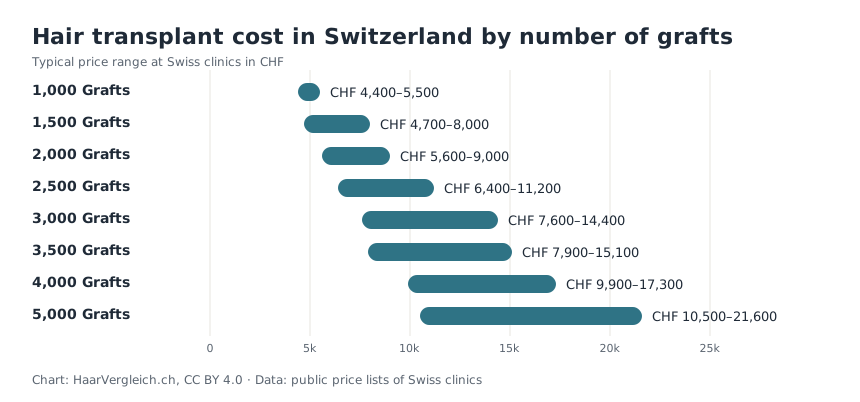
A 2,000-graft procedure typically costs CHF 6,000–10,000 in Switzerland. Our cost page shows current prices for all compared clinics. You can also estimate your graft number with our graft calculator.
Swiss quote vs Turkey package
| Item | Complete Swiss quote | Typical Turkey package |
|---|---|---|
| Diagnosis | in-person examination, often with trichoscopy | often photos via WhatsApp only |
| Surgeon | named doctor | often not specified |
| Graft number | justified, with price per graft | often a flat fee, sometimes "unlimited" |
| Check-ups | at 1, 3, 6 and 12 months in person | usually by photo, remotely |
| Complications | clinic within reach | often treated at home, at your own cost |
| Travel and hotel | not needed | in the package, flights usually extra |
A Turkey package costs around CHF 1,800–3,500; with flights, extras and follow-up the total is about CHF 2,700–5,100. Corrections after a poor result often cost CHF 5,000–12,000 in Switzerland. A review notes that large price differences may reflect differences in resources, surgeon experience and safety protocols [5].
Practical tips for English speakers
Check that the surgeon personally consults in English, not only the coordinator, and ask for the written quote and aftercare instructions in English too. If you live near Zurich, our overview of hair transplants in Zurich lists local options.
Hair transplants are almost never covered by Swiss health insurance, so you'll be comparing out-of-pocket prices. See our guide to health insurance and hair transplants for the exceptions and financing options.
Switzerland or abroad?
Procedures in Turkey are considerably cheaper. In exchange, you take on travel, language barriers, limited aftercare and more risk if complications arise. According to a recent review, the sector there lacks standardisation, oversight and consistent reporting of complications [5]. Read our honest comparison of Turkey vs Switzerland before you decide.
Compare clinics in Switzerland
We've compared the main clinics in Switzerland on expertise, aftercare, transparency, value for money and reviews. See the results in our clinic comparison.
Frequently asked questions
What is the best hair transplant clinic in Switzerland?
There is no single best clinic for everyone. The right one gives you a thorough medical diagnosis, a named and experienced surgeon, transparent pricing and structured aftercare. Compare at least two consultations against the same criteria.
How do I recognise a good hair transplant clinic?
Look for a proper medical diagnosis, transparent prices, honest statements about graft numbers and results, clearly named doctors and planned follow-up visits. A good clinic will also sometimes advise against surgery.
Should the surgeon perform the whole operation personally?
Many clinics work with a team of a doctor and specialised assistants. What matters is that the doctor is responsible for the planning, the hairline and the critical steps, and is present throughout the procedure. The ISHRS position is that a licensed provider should perform all surgical incisions and excisions.
How many consultations should I have?
At least two. That lets you check whether the recommended graft number, method and price are plausible.
How can I check a doctor's licence in Switzerland?
Search the federal register of medical professions, MedReg. It lists every doctor working in Switzerland with their diploma, specialist titles and cantonal licence to practise. The search is free and takes about a minute.
Do Swiss hair transplant clinics offer consultations in English?
Many clinics in Zurich, Geneva, Basel and Lausanne offer consultations in English. Ask in advance whether the surgeon, and not only the coordinator, speaks English well enough to discuss your plan in detail.
References
Numbers in the text refer to these sources. Links go to PubMed, the publisher (DOI) or the authority.
- FOPH (BAG): Medizinalberuferegister MedReg (in German).
- ISHRS: Warning of potential serious risk when unlicensed personnel perform hair transplantation surgery.
- ISHRS Fight the FIGHT: Hair Transplant Black Market Red Flags.
- Finner AM. [Hair transplantation-sustainably planned and performed by the physician]. Hautarzt 2022.PubMedDOI
- Haider SA, Hasanzade S, Borna S et al. The Allures and the Alarms of the Hair Transplant Tourism Industry. Aesthetic Plast Surg 2025.PubMedDOI
- Parsley WM, Perez-Meza D. Review of factors affecting the growth and survival of follicular grafts. J Cutan Aesthet Surg 2010.PubMedDOI
- Queen D, Avram MR. Hair Transplantation: State of the Art. Dermatol Surg 2025.PubMedDOI
- Liu Y, Liu F, Qu Q et al. Evaluating the Satisfaction of Patients Undergoing Hair Transplantation Surgery Using the FACE-Q Scales. Aesthetic Plast Surg 2019.PubMedDOI
This article is for general information and does not replace medical advice. Whether a treatment is right for you can only be determined by an examination with a specialist.