PRP (platelet-rich plasma) is a treatment in which a small amount of your own blood is spun in a centrifuge to concentrate the platelets, then injected into the thinning areas of the scalp. The growth factors in the platelets are thought to stimulate weakened hair follicles. In Switzerland a session typically costs CHF 300 to 700, and the evidence suggests a modest benefit, mainly as an add-on to other treatments [1,4].
In short: PRP is a reasonable add-on for pattern hair loss, especially alongside minoxidil or finasteride. It will not regrow hair on bald areas, and you need repeated sessions to maintain the effect.
How PRP works
Platelets contain growth factors involved in wound healing and tissue repair. The idea behind PRP for hair is that concentrating these growth factors and delivering them directly to the follicles can:
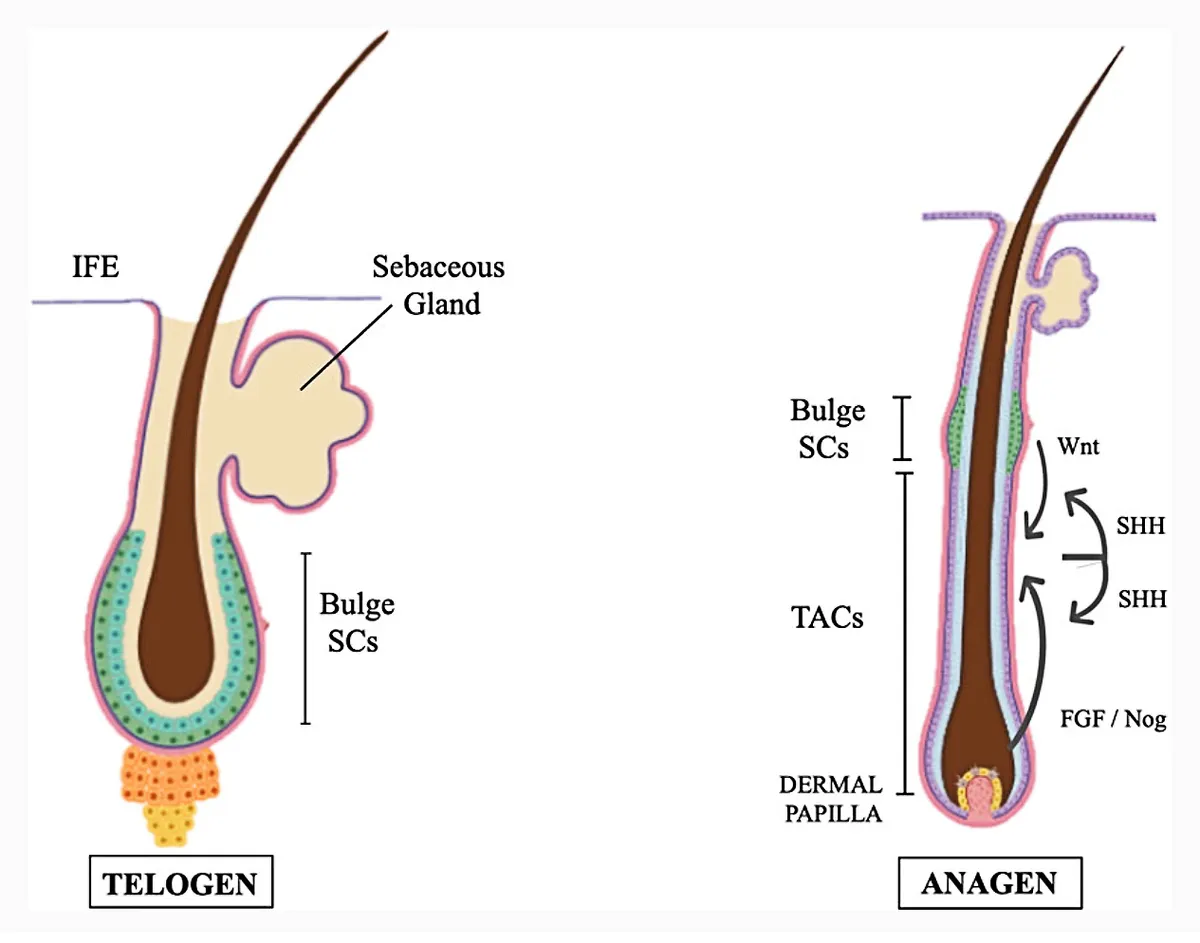
- prolong the growth phase of the hair cycle
- thicken miniaturised hairs
- improve blood supply around the follicles
PRP does not block DHT, the hormone that drives male pattern baldness. It therefore does not address the underlying cause of hereditary hair loss, which is why it is usually combined with finasteride or minoxidil.
The procedure step by step
A PRP session takes about 45 to 60 minutes:
- Blood draw: around 10 to 60 ml of blood is taken from your arm, similar to a routine blood test.
- Centrifuge: the blood is spun for about 10 to 15 minutes to separate the platelet-rich plasma from the red cells.
- Numbing: the scalp is numbed with cream, cooling or local anaesthetic.
- Injections: the plasma is injected in small amounts across the thinning areas, sometimes combined with microneedling.
- Afterwards: you can go home straight away. Avoid washing your hair, saunas and intense exercise for about 24 hours.
Side effects are usually mild: tenderness, redness, slight swelling or a headache for a day or two; trials report mainly temporary pain, minor bleeding and itching [3]. Infection is rare when the procedure is done under sterile conditions.
PRP is not suitable for everyone. Let your doctor know if you have a blood or platelet disorder, take anticoagulants, have an active scalp infection, or are being treated for cancer.
What does the evidence say?
PRP has been studied in a growing number of trials and reviews. Overall:
- many studies report a modest improvement in hair density and thickness in androgenetic alopecia compared with placebo injections [2,3]
- the studies are mostly small, with short follow-up, and reviewers rate the overall evidence as low quality [1]
- protocols differ widely: how the plasma is prepared, platelet concentration, injection technique and session frequency [1,4]
- adding PRP to topical minoxidil improved density more than minoxidil alone in a few small trials, though with very low-certainty evidence [4]
- there is no standardised, approved PRP product for hair loss
That means PRP is plausible and generally safe, but the quality of the evidence is lower than for finasteride or minoxidil. A clinic that promises dramatic regrowth from PRP alone is overselling. How PRP compares with other options is shown in our overview of what the research on hair loss treatments shows.
PRP works best for people with early to moderate thinning, where follicles are still present. On scalp that has been smooth and bald for years, there is nothing left to stimulate.
Who is a good candidate?
PRP is most likely to help if:
- you have androgenetic alopecia at an early or moderate stage, with thinning rather than bald areas
- you already use, or are willing to use, minoxidil or finasteride
- you want to support hair after a transplant
- you have no blood disorder and are not on anticoagulants
It is less useful for advanced baldness, scarring alopecia or hair loss caused by a deficiency or thyroid problem. In those cases, the cause has to be treated first. Our overview of hair loss causes explains the different forms.
Questions to ask a clinic
Because PRP protocols vary so much, ask before you book:
- Who performs the injections, a doctor or a nurse?
- Which preparation system is used, how much blood is drawn, and is the platelet count measured? Not every clinic does; Mara in Zurich is one that does.
- How many sessions are planned, and how is the result measured?
- Are standardised photos or trichoscopy taken before and after?
- What does a full course cost, including maintenance?
A good clinic will answer these clearly and will not promise results it cannot measure.
Typical treatment schedule
| Phase | Frequency | Purpose |
|---|---|---|
| Initial course | 3–4 sessions, 4–6 weeks apart | Build up the effect |
| Assessment | About 3 months after the last session | Photos and comparison |
| Maintenance | Every 6–12 months | Keep the effect |
An expert committee of the International Society of Hair Restoration Surgery recommends three monthly sessions followed by maintenance [2]. Results, if any, typically become visible three to six months after starting. If you see no difference after the initial course, more sessions are unlikely to change much.
Cost of PRP hair treatment in Switzerland
| Item | Approximate cost |
|---|---|
| Single session | CHF 300–700 |
| Initial course (3–4 sessions) | CHF 900–2,800 |
| Maintenance per year (1–2 sessions) | CHF 300–1,400 |
| Package deals | Often 10–20% cheaper per session |
Prices depend on the preparation system, whether a doctor or nurse performs the injections, and the location; clinics in Zurich and Geneva tend to be at the upper end. PRP is not covered by basic health insurance. More on what insurers pay in our health insurance guide.
Over five years, PRP can easily cost several thousand francs. Compare that with medication costs and, if relevant, with a one-off transplant.
PRP and a hair transplant
Many clinics offer PRP alongside a hair transplant:
- During surgery: grafts are sometimes stored in PRP, or PRP is injected into the recipient area, to support healing.
- After surgery: sessions in the first months are offered to reduce shock loss and support growth.
Evidence for these uses is limited, but they are generally safe. Ask whether PRP is included in the transplant price or charged separately. Our recovery timeline explains what to expect in the months after the procedure.
When a hair transplant makes sense
PRP and medication can slow thinning and thicken existing hair. They cannot refill a bald hairline or crown. If your temples are clearly receding or the crown is shiny, see where you are on the Norwood scale and what a procedure would cost in our cost overview.
A Swiss clinic can assess your hair loss, set up a combined plan of medication, PRP and surgery if needed, and handle aftercare locally. Compare providers in our clinic comparison or start with clinics for a hair transplant in Zurich.
Frequently asked questions
Does PRP really work for hair loss?
Studies suggest PRP can modestly improve hair density and thickness in pattern hair loss, but the studies are small and use very different protocols. It works best as an add-on to medication, not as a replacement, and results vary from person to person.
How much does PRP hair treatment cost in Switzerland?
Most Swiss clinics charge around CHF 300 to 700 per session. An initial course of three to four sessions therefore costs about CHF 900 to 2,800, plus maintenance sessions once or twice a year.
How many PRP sessions do I need?
A typical protocol is three to four sessions four to six weeks apart, followed by maintenance sessions every six to twelve months. Your doctor may adjust this depending on how you respond.
Is PRP for hair painful?
The injections are uncomfortable rather than painful for most people. Clinics use numbing cream, cooling or local anaesthetic. The scalp may feel tender and slightly swollen for a day or two.
Is PRP covered by health insurance in Switzerland?
No. PRP for hair loss is considered a cosmetic treatment and is not covered by basic health insurance. Supplementary insurance rarely pays for it either.
References
Numbers in the text refer to these sources. Links go to PubMed, the publisher (DOI) or the authority.
- Cruciani M, Masiello F, Pati I et al. Platelet-rich plasma for the treatment of alopecia: a systematic review and meta-analysis. Blood Transfus 2023.PubMedDOI
- Gupta AK, Cole J, Deutsch DP et al. Platelet-Rich Plasma as a Treatment for Androgenetic Alopecia. Dermatol Surg 2019.PubMedDOI
- Papakonstantinou M, Siotos C, Gasteratos KC et al. Autologous Platelet-Rich Plasma Treatment for Androgenic Alopecia: A Systematic Review and Meta-Analysis of Clinical Trials. Plast Reconstr Surg 2023.PubMedDOI
- Yao J, Zhu L, Pan M et al. The additive value of platelet-rich plasma to topical Minoxidil in the treatment of androgenetic alopecia: A systematic review and meta-analysis. PLoS One 2024.PubMedDOI
This article is for general information and does not replace medical advice. Whether a treatment is right for you can only be determined by an examination with a specialist.