A hair transplant moves hair follicles from the back of the head, where they resist hereditary hair loss, to thinning or bald areas. In Switzerland, the procedure is done under local anaesthetic in a day and typically costs CHF 6,000 to 10,000 for 2,000 grafts. Studies report that around 85 to 95% of transplanted grafts survive [3,4,5]. The final result is visible after 12 to 18 months.
In short: A hair transplant is the only permanent way to restore hair to bald areas caused by pattern hair loss. Success depends far more on diagnosis, planning and the surgical team than on the method's name. In Switzerland you pay more than abroad, but you get local aftercare, clear accountability and easy follow-up.
This guide gives you the full picture, from candidacy and methods to cost, recovery and choosing a clinic. Each section links to a detailed guide.
What is a hair transplant?
Hereditary hair loss (androgenetic alopecia) is driven by the hormone DHT, which gradually shrinks hair follicles on the top of the head. Follicles at the back and sides are genetically resistant to DHT. During a transplant, a surgical team removes small groups of these follicles, called grafts or follicular units, and implants them where hair is thinning.
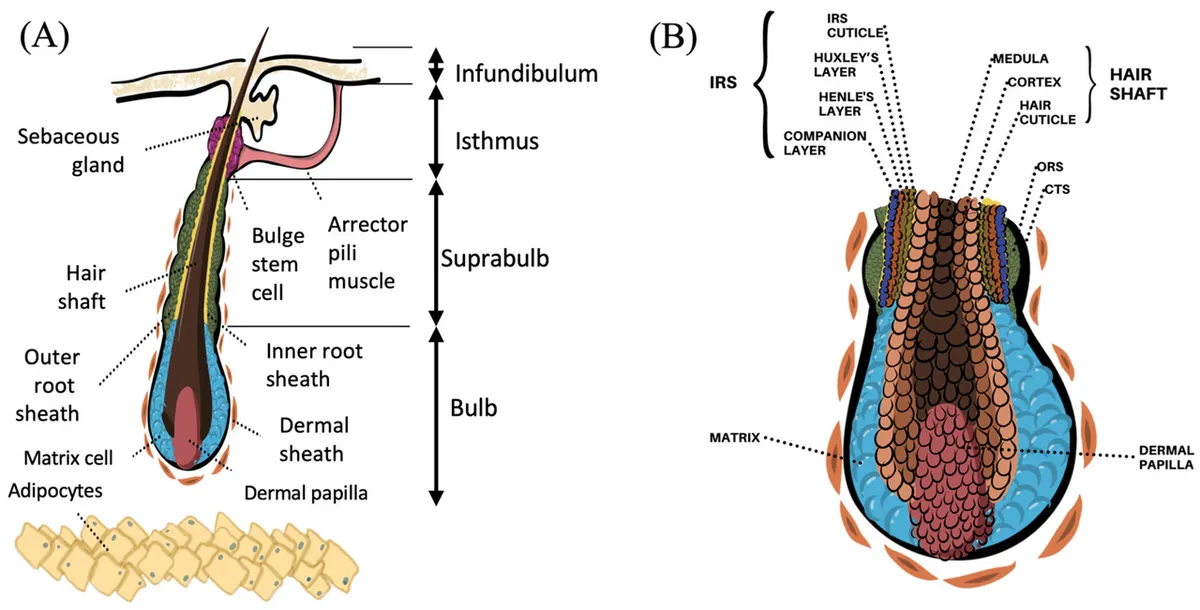
Because the transplanted follicles keep their resistance, they usually keep growing for life. A transplant redistributes hair; it does not create new hair. Your donor supply is therefore limited and has to be planned carefully over your lifetime.
Who is a good candidate?
You are likely to be a good candidate if:
- you have pattern hair loss confirmed by a doctor
- your hair loss is reasonably stable, or controlled with medication
- you have enough donor hair at the back and sides of your head
- your expectations are realistic about density and the need for medication
You may not be a good candidate if you are very young with rapidly progressing loss, have diffuse thinning with a weak donor area, or have active alopecia areata or a scarring hair loss condition. Hair loss with a different cause, such as alopecia areata, needs a different treatment; see our guide to JAK inhibitors for alopecia areata.
Check where you stand on the Norwood and Ludwig scales.
Age and timing
There is no fixed minimum age, but many surgeons are cautious with men in their early twenties. At that age, the final pattern of hair loss is hard to predict. A low, dense hairline that looks good at 23 can look out of place at 40 if the crown and temples keep receding, and the donor supply needed to fix it may no longer be there. A common approach is to stabilise hair loss with medication first, then decide on surgery once the pattern is clearer.
Women
Women more often have diffuse thinning across the top of the head rather than a receding hairline. That makes them good candidates less often, because the donor area at the back may be thinning too. A transplant can still work well for women with a stable, well-defined thinning area, a high hairline or hair loss after surgery or traction. A thorough diagnosis, including blood tests for hormonal or nutritional causes, is essential. See our page on hair transplants for women.
Methods compared: FUE, DHI, FUT and unshaven
All modern methods transplant follicular units. They differ in how the grafts are harvested from the donor area and how they are implanted.
| Method | How grafts are harvested | How they are implanted | Best suited for | Main trade-off |
|---|---|---|---|---|
| FUE (incl. sapphire FUE) | Individually with a fine punch | Into pre-made incisions with forceps | Large areas, high graft numbers | Usually requires shaving |
| DHI | Individually with a fine punch | Directly with an implanter pen | Hairlines, densification | Slower, often 10–30% more expensive |
| FUT (strip) | A strip of scalp is removed and dissected | Into pre-made incisions | Large sessions, preserving donor reserve | Linear scar at the back |
| Unshaven FUE/DHI | Individually, with limited or no shaving | Between existing hairs | Small sessions, discretion | Fewer grafts per session, higher price |
A critical review concluded that FUE and FUT both produce high-quality grafts. The main difference lies in the donor scarring: FUT leaves a linear scar, FUE leaves small dot scars that are usually easy to hide [1]. In a study of patients who had both procedures with the same surgeon, FUE yielded more multi-hair grafts. The authors still concluded that neither technique was superior, because the right choice depends on the individual case [2].
DHI and sapphire FUE use the same harvesting technique as FUE and differ only in how grafts are implanted. Read our detailed comparison of FUE vs DHI.
How many grafts do you need?
The number of grafts depends on the size of the area, the density you want and your donor reserve. One graft contains about one to four hairs, roughly two to two and a half on average.
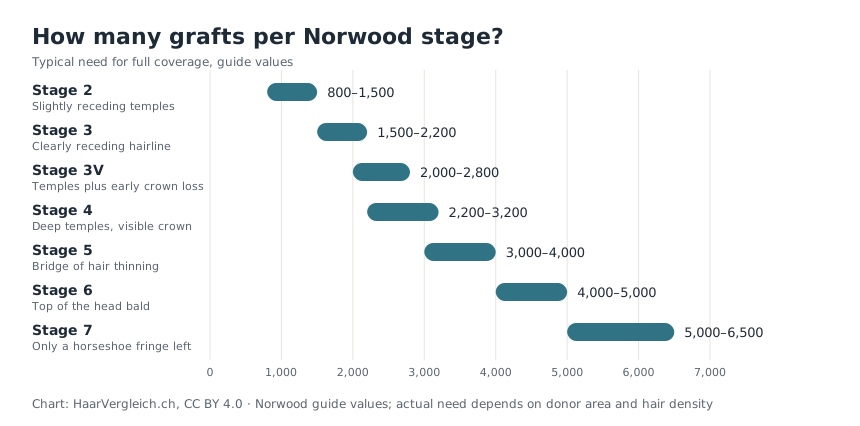
| Stage | Typical graft range |
|---|---|
| Norwood 2 (mild receding temples) | 800–1,500 |
| Norwood 3 (clear receding temples) | 1,500–2,200 |
| Norwood 4 | 2,200–3,000 |
| Norwood 5 | 3,000–3,800 |
| Norwood 6–7 | 3,800–6,000, often in two sessions |
These are guide values. Get a personal estimate with our graft calculator, and read more in our guide on how many grafts you need.
Your donor area is a limited budget
The back and sides of the scalp can only supply a finite number of grafts over a lifetime. Experienced surgeons spread extractions evenly and avoid taking too many from one area, so the donor zone still looks full. They also keep a reserve for a possible second session later. Promises of very high graft numbers in a single session should prompt questions about how the donor area will look afterwards.
Preparing for your transplant
Your clinic will give you specific instructions. Typical recommendations include:
- Medication review: tell the clinic about all medicines and supplements, especially blood thinners. Some may need to be paused, but only after agreement with the prescribing doctor.
- Alcohol and smoking: many clinics advise avoiding alcohol for a few days before surgery and reducing or stopping smoking, which can impair wound healing.
- Topical minoxidil: often paused a few days before surgery.
- Haircut: don't cut your hair very short beforehand unless the clinic asks you to; longer hair can help hide the donor area afterwards.
- Time off: plan for roughly a week away from visible work if you want the recipient area to heal before returning.
- Travel: arrange to be driven home, as you may receive a sedative.
The procedure step by step
A typical session takes most of a day:
- Consultation and planning: diagnosis, discussion of goals, hairline design and graft estimate.
- Preparation: the donor area (and with FUE usually the recipient area) is shaved; photographs are taken.
- Local anaesthetic: injected into the donor and recipient areas. You stay awake.
- Harvesting: grafts are extracted one by one (FUE/DHI) or as a strip (FUT).
- Graft storage: grafts are sorted and kept in a holding solution.
- Implantation: channels are opened and grafts placed, or grafts are inserted directly with a DHI pen.
- Aftercare instructions: dressing, medication and the first hair wash.
Large sessions are possible. In one series, 273 men with advanced hair loss received 3,000 to 6,000 grafts in a single session lasting 6 to 12 hours [5]. Expert consensus stresses that standardised steps, from harvesting to graft storage and implantation, help maximise graft survival [10].
Recovery: what to expect
| Time | What usually happens |
|---|---|
| Days 1–3 | Redness, small crusts, possible swelling of the forehead |
| Days 7–14 | Scabs fall off; back to office work |
| Weeks 2–8 | Transplanted hairs shed (normal "shock loss") |
| Months 3–4 | First new hairs |
| Month 6 | Roughly half of the result |
| Months 12–18 | Final result, especially at the crown |
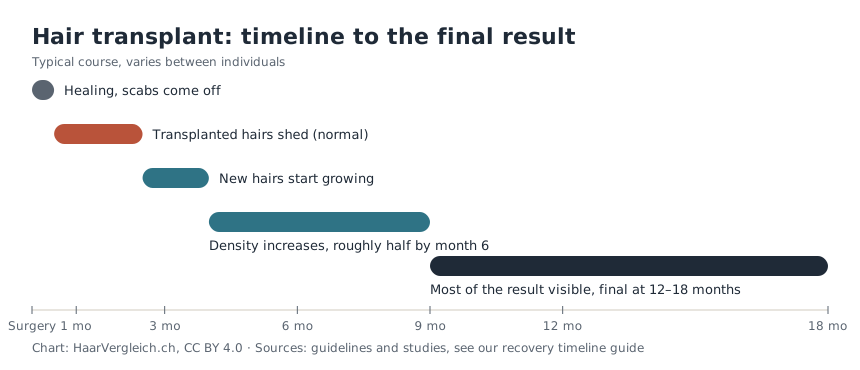
Following aftercare instructions matters. In a multicentre study of 1,090 patients, redness around the grafts was linked to lower graft survival. Folliculitis and washing the hair too late after surgery were risk factors [8]. See our month-by-month recovery timeline.
Results and graft survival
A meta-analysis of hair restoration studies found pooled graft survival of about 85 to 93% and satisfaction of 90 to 97% in non-scarring hair loss [3]. Recent FUE series report similar figures: more than 90% graft survival and over 98% satisfaction in 158 men [4], and 93.5 to 96.6% survival in megasessions [5]. In a prospective study, quality of life, stress and anxiety scores improved after FUE [6].
Two caveats: these data mostly come from specialist centres reporting their own results, and a second session is not unusual in advanced hair loss. In the megasession series, 19% later had another procedure for more density [5]. Read our full evidence review on the hair transplant success rate.
Risks and side effects
Expected, temporary effects include swelling, redness, crusting, numbness and shock loss. Less common complications include:
- folliculitis or infection
- poor graft growth
- visible donor scarring or an overharvested, "moth-eaten" donor area
- an unnatural hairline or wrong hair direction
Outcomes after FUE are largely operator-dependent. Complications are more frequent when untrained doctors perform the procedure or when it is delegated to unlicensed staff [7]. Read our detailed guide to hair transplant risks.
Cost in Switzerland vs Turkey
| Switzerland | Turkey | |
|---|---|---|
| Price per graft | about CHF 3–6 | package price |
| 2,000 grafts | CHF 6,000–10,000 | CHF 1,800–3,500 package |
| Realistic total incl. travel, extras, follow-up | CHF 6,000–10,000 | about CHF 2,700–5,100 |
| Aftercare | local, in person | mostly remote |
| Corrections if needed | – | often CHF 5,000–12,000 at home |
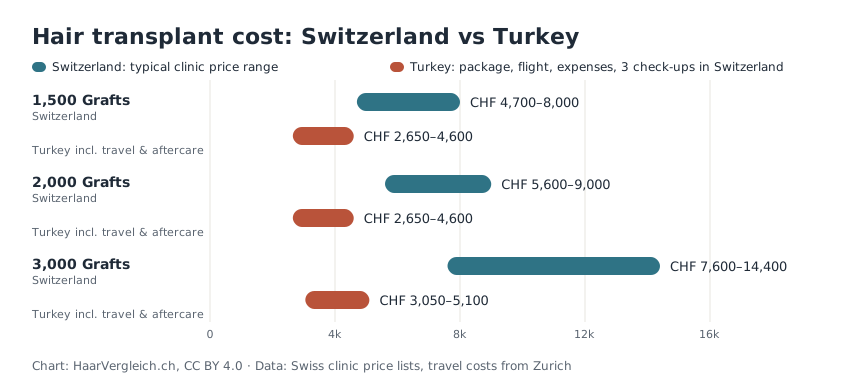
Swiss clinics usually price per graft; DHI and unshaven techniques cost more. Health insurance does not normally cover a transplant for pattern hair loss; see our guide to health insurance. For current prices and examples, see our cost guide and the breakdown for 2,000 grafts.
Turkey, especially Istanbul, is the centre of hair transplant tourism. A 2025 review warned of a largely unregulated environment with unsupervised technicians and bait-and-switch practices, as well as a "data black hole" around complications. It noted that large price differences may reflect differences in surgeon experience and safety protocols [9]. Compare both options in Turkey vs Switzerland and read about hair transplant risks in Turkey.
How to choose a clinic
The method matters less than the people using it. Questions to ask in the consultation:
- Who makes the diagnosis and designs the hairline? It should be a doctor experienced in hair surgery.
- Who harvests and implants the grafts? Ask which steps the doctor performs personally.
- How is the donor area managed? Overharvesting cannot be undone.
- How are grafts stored, and for how long are they outside the body?
- What aftercare and follow-up are included?
- Can you see unedited before-and-after photos of similar cases?
Our guide on choosing a clinic contains a full checklist. Compare Swiss providers, methods and prices in our clinic comparison, for example in Zurich.
Medication alongside a transplant
A transplant restores hair to bald areas but does not stop ongoing hair loss in the native hair around it. Without treatment, the result may look patchy over the years. Medication is therefore a common part of the plan:
- Finasteride 1 mg (men, prescription) and minoxidil are among the best-studied treatments. Finasteride gave the largest gain in terminal hairs at 48 weeks in a network meta-analysis [11]. The European S3 guideline gives evidence-based treatment recommendations for androgenetic alopecia in men and women [12].
- Oral minoxidil is an off-label option; see our oral minoxidil review.
- Timing: many surgeons pause topical minoxidil a few days before surgery and restart it once the scabs have gone. Follow your clinic's instructions.
For the evidence behind each option, see our hair loss treatment evidence overview, as well as the guides to finasteride and minoxidil.
Next steps
- Get a diagnosis and check your stage on the hair loss scale.
- Estimate your graft needs with the graft calculator.
- Compare clinics and prices in our clinic comparison.
- Request a free, no-obligation assessment from Swiss clinics.
All articles on Hair transplants
Frequently asked questions
How much does a hair transplant cost in Switzerland?
Swiss clinics typically charge CHF 3 to 6 per graft, so 2,000 grafts usually cost CHF 6,000 to 10,000. Prices depend on the method, the number of grafts and who performs the procedure. Health insurance does not normally pay for hair transplants for pattern hair loss.
Is a hair transplant permanent?
The transplanted hair comes from the back of the head, where follicles are resistant to the hormone DHT, so it usually keeps growing for life. The native hair around the transplant can continue to thin, which is why many patients also use medication.
Does a hair transplant hurt?
The procedure is done under local anaesthetic, so the injections at the start are the most uncomfortable part. Afterwards most patients describe tightness or mild pain for a few days, which is usually controlled with standard painkillers.
How long does it take to see results?
The transplanted hairs usually fall out within 2 to 8 weeks, then regrow from about month 3 or 4. Around half of the result is visible after 6 months and the final result after 12 to 18 months.
Who is a good candidate for a hair transplant?
Good candidates have stable pattern hair loss, enough donor hair at the back and sides of the head and realistic expectations. Very young men with rapidly progressing loss and people with active alopecia areata or scarring conditions are usually not good candidates.
Is a hair transplant in Turkey cheaper than in Switzerland?
Turkish packages often cost CHF 1,800 to 3,500, but with flights, extras and follow-up the total is closer to CHF 2,700 to 5,100. Quality varies widely, and aftercare and corrections at home can add significant costs.
References
Numbers in the text refer to these sources. Links go to PubMed, the publisher (DOI) or the authority.
- Gupta AK, Love RP, Harris JA. Old Friend or New Ally: A Comparison of Follicular Unit Transplantation and Follicular Unit Excision Methods in Hair Transplantation. Dermatol Surg 2020.PubMedDOI
- Takata Pontes L, Ruston A, de Moraes AM. Strip Harvesting Follicular Unit Transplantation Versus Follicular Unit Excision: Comparing the Number of Hairs and the Ratio of Hairs to Follicular Unit. Dermatol Surg 2024.PubMedDOI
- Stoneburner J, Shauly O, Carey J et al. Contemporary Management of Alopecia: A Systematic Review and Meta-analysis for Surgeons. Aesthetic Plast Surg 2020.PubMedDOI
- Wang F, Chen Y, Yang C et al. Using the follicular unit extraction technique in treatment of male androgenetic alopecia. BMC Surg 2024.PubMedDOI
- Li KT, Qu Q, Fan ZX et al. Clinical experience on follicular unit extraction megasession for severe androgenetic alopecia. J Cosmet Dermatol 2020.PubMedDOI
- Maletic A, Dumic-Cule I, Zic R et al. Impact of Hair Transplantation on Quality of Life. Aesthetic Plast Surg 2024.PubMedDOI
- Williams KL Jr, El-Maghraby S. Complications with Follicular Unit Excision. Facial Plast Surg 2024.PubMedDOI
- Zhang J, Zhao Y, Zhang J et al. Risk Factors and Hazards of Recipient-Area Perifollicular Erythema After Hair Transplantation: A Multicenter Retrospective Cohort Study. Aesthetic Plast Surg 2024.PubMedDOI
- Haider SA, Hasanzade S, Borna S et al. The Allures and the Alarms of the Hair Transplant Tourism Industry. Aesthetic Plast Surg 2025.PubMedDOI
- Zhang J, Zhang J, Wu W et al. Enhancing Graft Survival Rates in Follicular Unit Excision: A Chinese Expert Consensus on Perioperative Procedures. Plast Reconstr Surg 2025.PubMedDOI
- Gupta AK, Venkataraman M, Talukder M et al. Relative Efficacy of Minoxidil and the 5-α Reductase Inhibitors in Androgenetic Alopecia Treatment of Male Patients: A Network Meta-analysis. JAMA Dermatol 2022.PubMedDOI
- Kanti V, Messenger A, Dobos G et al. Evidence-based (S3) guideline for the treatment of androgenetic alopecia in women and in men - short version. J Eur Acad Dermatol Venereol 2018.PubMedDOI
This article is for general information and does not replace medical advice. Whether a treatment is right for you can only be determined by an examination with a specialist.