Minoxidil is a medicine that prolongs the growth phase of hair follicles and enlarges thinning follicles. Applied to the scalp as a 5% or 2% solution or foam, it slows hereditary hair loss and regrows some hair in many users [2,3]. In Switzerland, topical minoxidil is sold without a prescription in pharmacies; low-dose oral minoxidil is prescribed off-label by doctors.
In short: Minoxidil works, but only while you use it. Expect some shedding in the first weeks, judge the result after 6 to 12 months, and talk to a doctor before switching to tablets.
How minoxidil works
Minoxidil was originally developed as a blood pressure tablet. Doctors noticed that patients grew more hair, and a topical version was later approved for hair loss.
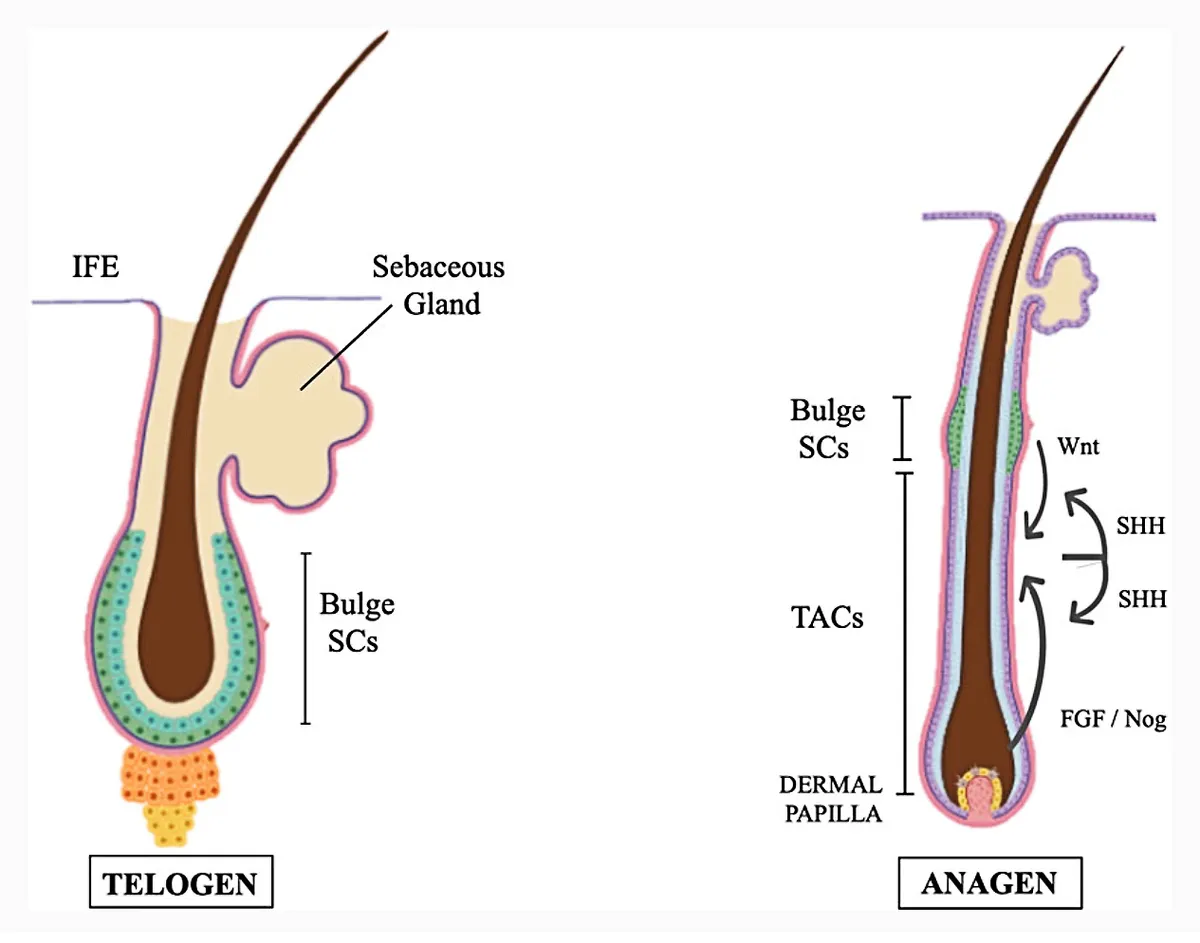
Its exact mechanism is still not fully understood. What is known:
- it shortens the resting phase (telogen) and lengthens the growth phase (anagen) of the hair cycle
- it enlarges miniaturised follicles, so thin hairs become thicker
- it improves blood supply around the follicle [1]
Minoxidil does not block DHT, the hormone that drives male pattern baldness. That is why it is often combined with finasteride, which does.
Forms and dosage
| Form | Who | Typical dose | Status in Switzerland |
|---|---|---|---|
| 5% solution | Men | 1 ml twice daily on dry scalp | Without prescription (pharmacy) |
| 5% foam | Men | Half a capful twice daily | Without prescription (pharmacy) |
| 2% solution | Women | 1 ml twice daily | Without prescription (pharmacy) |
| 5% foam | Women | Half a capful once daily | Without prescription (pharmacy) |
| Oral, low-dose | Men | about 1.25–5 mg per day | Prescription, off-label |
| Oral, low-dose | Women | about 0.625–2.5 mg per day | Prescription, off-label |
Topical minoxidil is sold in Switzerland under brand names such as Regaine and as generic versions. Apply it to the thinning area of a dry scalp, not to the hair, and wash your hands afterwards. More than the recommended dose does not work better, it only increases side effects.
Oral minoxidil
Low-dose oral minoxidil has become popular because one small tablet a day is easier than twice-daily scalp application. Studies suggest it is roughly as effective as the topical form [4]. It is not licensed for hair loss in Switzerland, so a doctor prescribes it off-label, often as low-dose capsules made up by a pharmacy. Doses, trial results and side-effect data are covered in detail in our guide to oral minoxidil for hair loss.
Before starting, your doctor should check your blood pressure, pulse and medical history. People with heart disease, low blood pressure or kidney problems usually should not take it.
The shedding phase and timeline
Many people panic in the first weeks because their hair falls out faster. This "dread shed" is a sign that the medicine is working: resting hairs are pushed out so that new growing hairs can take their place.
| Time | What usually happens |
|---|---|
| Weeks 2–8 | Increased shedding, sometimes noticeable |
| Months 2–4 | Shedding settles, first fine new hairs |
| Months 4–6 | Visible improvement in density for many users |
| Months 6–12 | Full effect; time to judge whether it works for you |
Minoxidil only works while you keep using it. If you stop, the extra hair is usually lost again within a few months.
Side effects
Topical minoxidil
- Scalp irritation: itching, flaking or redness. Often caused by propylene glycol in the solution; the foam is usually better tolerated.
- Temporary shedding in the first weeks (see above).
- Unwanted hair growth on the forehead or face, more common in women and usually from the product running onto the skin.
- Rarely: headache, dizziness or palpitations if a lot is absorbed.
Keep minoxidil away from pets. It is highly toxic to cats, even in small amounts on pillows or hands.
Oral minoxidil
- Increased body and facial hair (hypertrichosis), the most common side effect, especially in women [4,5]
- Fluid retention, such as swollen ankles
- Faster heartbeat, dizziness or headache; in a study of 1,404 patients these systemic effects were each reported by under 2% [5]
- Very rarely, more serious heart effects, mainly at higher doses
See a doctor promptly if you notice chest pain, shortness of breath, marked swelling or a racing heart. Minoxidil in any form should not be used during pregnancy or breastfeeding.
Minoxidil for women and for the beard
Women respond well to minoxidil, and it is the first-line treatment for female pattern hair loss [3,6]. In trials, the 2% and 5% strengths worked about equally well in women [6]. The 5% foam once daily is often more convenient than the 2% solution twice daily. Read more in our guide to hair loss in women.
Beard: some men use 5% topical minoxidil off-label on patchy beard areas. Small studies show a modest effect, but results vary widely and some of the new hair may thin again after stopping. Apply it carefully, as facial skin irritates more easily than the scalp.
Cost per month in Switzerland
Minoxidil for hair loss is considered a lifestyle treatment and is generally not covered by basic health insurance. Approximate monthly costs:
| Treatment | Approximate cost per month |
|---|---|
| Topical 5% solution or foam (brand) | CHF 25–45 |
| Topical generic | CHF 15–30 |
| Oral low-dose (pharmacy capsules) | CHF 10–30, plus doctor's visits |
Over ten years, topical minoxidil alone can cost CHF 2,000–5,000. That is worth knowing when you compare long-term treatment with other options.
Minoxidil and a hair transplant
Minoxidil cannot regrow hair on a scalp that has been bald for years. It is best at protecting and thickening the hair you still have. A hair transplant moves DHT-resistant hair from the back of the head to bald areas. The two complement each other:
- Before surgery: many surgeons ask you to pause topical minoxidil a few days to a week before the procedure, as it can increase bleeding at the scalp. Follow your clinic's instructions.
- After surgery: topical minoxidil is usually restarted once the scabs have gone, often after one to two weeks. Some surgeons use it to reduce shock loss and to speed up regrowth. Oral minoxidil is handled case by case.
- Long term: minoxidil helps keep the native hair around the transplant, so the result does not look patchy as hair loss progresses.
See our recovery timeline for what happens in the months after surgery.
When a hair transplant makes sense
If you have used minoxidil for a year and your temples or crown are still clearly thinning, or if the bald areas are smooth and shiny, medication alone will not fill them. Check your stage on the Norwood scale and see what a procedure would cost in our cost overview.
A Swiss clinic can combine diagnosis, a medication plan and surgery in one place, with follow-up appointments close to home. Compare providers in our clinic comparison.
Frequently asked questions
Does minoxidil really work for hair loss?
Yes, for pattern hair loss it is one of only a few treatments with solid evidence. Most users see slower hair loss and some regrowth, especially on the crown, after 4 to 6 months. It works less well on completely bald areas and only as long as you keep using it.
What are the side effects of minoxidil?
Topical minoxidil most often causes scalp itching, flaking or redness and temporary shedding in the first weeks. Unwanted facial or body hair is possible, especially in women. Oral minoxidil can also cause ankle swelling, a faster heartbeat or dizziness, so it needs a doctor's supervision.
Is oral minoxidil better than topical?
Low-dose oral minoxidil appears to work about as well as topical minoxidil in studies and is easier to use, but it has more body-wide side effects. In Switzerland it is prescribed off-label, so it requires a doctor who knows your blood pressure and heart history.
Can women use minoxidil?
Yes. Women typically use the 2% solution twice daily or the 5% foam once daily. Low-dose oral minoxidil is also prescribed off-label for women. Minoxidil must not be used during pregnancy or breastfeeding.
Does minoxidil work for beard growth?
Some men use topical minoxidil off-label to thicken a patchy beard, and small studies suggest a modest effect. Results vary a lot, and some of the new hair may thin again after stopping.
What happens if I stop using minoxidil?
The hair gained or maintained thanks to minoxidil is usually lost again within about 3 to 6 months of stopping. Your hair then returns to the level it would have reached without treatment.
References
Numbers in the text refer to these sources. Links go to PubMed, the publisher (DOI) or the authority.
- Gupta AK, Talukder M, Venkataraman M et al. Minoxidil: a comprehensive review. J Dermatolog Treat 2022.PubMedDOI
- Adil A, Godwin M. The effectiveness of treatments for androgenetic alopecia: A systematic review and meta-analysis. J Am Acad Dermatol 2017.PubMedDOI
- Kanti V, Messenger A, Dobos G et al. Evidence-based (S3) guideline for the treatment of androgenetic alopecia in women and in men - short version. J Eur Acad Dermatol Venereol 2018.PubMedDOI
- Sobral MVS, Moreira JLML, Rodrigues LK et al. Efficacy and safety of oral minoxidil versus topical solution in androgenetic alopecia: a meta-analysis of randomized clinical trials. Int J Dermatol 2025.PubMedDOI
- Vañó-Galván S, Pirmez R, Hermosa-Gelbard A et al. Safety of low-dose oral minoxidil for hair loss: A multicenter study of 1404 patients. J Am Acad Dermatol 2021.PubMedDOI
- van Zuuren EJ, Fedorowicz Z, Schoones J. Interventions for female pattern hair loss. Cochrane Database Syst Rev 2016.PubMedDOI
This article is for general information and does not replace medical advice. Whether a treatment is right for you can only be determined by an examination with a specialist.