A receding hairline is when the hair at the temples and front of the head moves progressively backwards, usually forming an M-shape. In most men it is the first sign of hereditary hair loss (androgenetic alopecia). Medication can often stop it, and a hair transplant can restore a hairline that has already receded.
In short: A slightly higher, mature hairline is normal. If it keeps moving back, start treatment early: finasteride and minoxidil help stop it, a transplant of about 800 to 2,200 grafts can rebuild it.
Mature vs receding hairline
Almost every man's hairline changes between the late teens and about 30. The juvenile hairline, which sits low and straight, moves back by about 1 to 1.5 cm at the temples. This is a mature hairline, and it is not a sign of baldness.
| Mature hairline | Receding hairline | |
|---|---|---|
| How far back | About 1–1.5 cm above the top forehead crease | Further, and progressing |
| Shape | Even, slightly higher at the temples | Deepening M-shape |
| Hair quality | Normal thickness | Finer, shorter hairs at the edges |
| Progression | Stops after a few years | Continues over time |
| Other signs | None | Crown thinning, family history |
A simple check: take photos of your hairline from the same angle every three to six months. If the temples keep moving back or the hair becomes wispy, it is likely a receding hairline.
Why the hairline recedes
In the vast majority of men, a receding hairline is caused by androgenetic alopecia, which affects up to 80% of Caucasian men and often begins in the teenage years [1]. The follicles at the temples and on top of the head are genetically sensitive to dihydrotestosterone (DHT). Over years, they shrink and produce thinner hair until they stop.
The hair at the back and sides of the head is resistant to DHT. That is why it is used as donor hair in a transplant: moved follicles keep their original characteristics, a principle called donor dominance [3].
Less common causes include traction alopecia from tight hairstyles and frontal fibrosing alopecia, a rare scarring condition that has become more common in recent decades and is best treated early [5]. If your hairline recedes together with eyebrow loss or scalp redness, see a dermatologist. For an overview of all forms, see our guide to hair loss.
Receding hairline treatment without surgery
The goal of medication is to stop further loss and thicken hair that is still there:
- Finasteride: a prescription tablet that lowers DHT. It stops hair loss in most men, but sexual and mood side effects should be discussed with a doctor.
- Minoxidil: a solution or foam available without prescription in Swiss pharmacies, or low-dose tablets prescribed off-label. Helps thicken thinning hair.
- PRP: injections of growth factors from your own blood, used as an add-on.
Finasteride and minoxidil work in different ways and are often combined for an additive effect in men [1,2].
Medication works better on the crown than on the temples, and it rarely refills areas that are completely bald. Expect to wait six to twelve months before judging the result.
Hairline transplant: grafts by stage
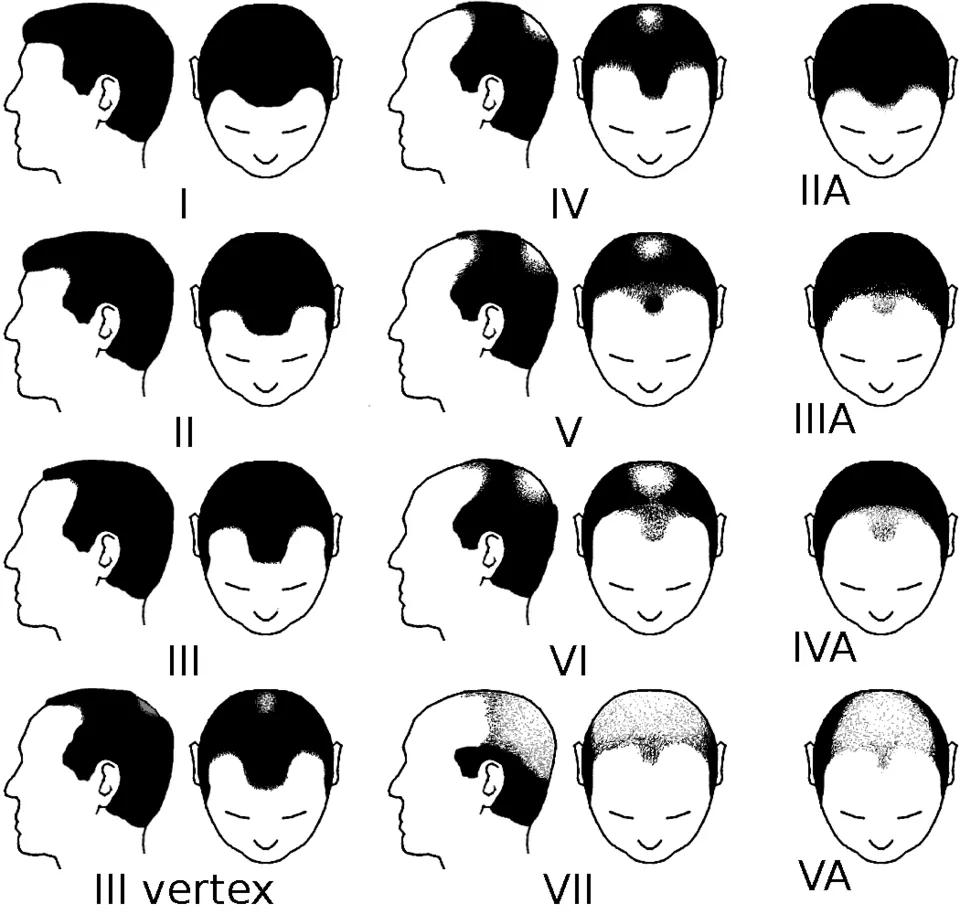
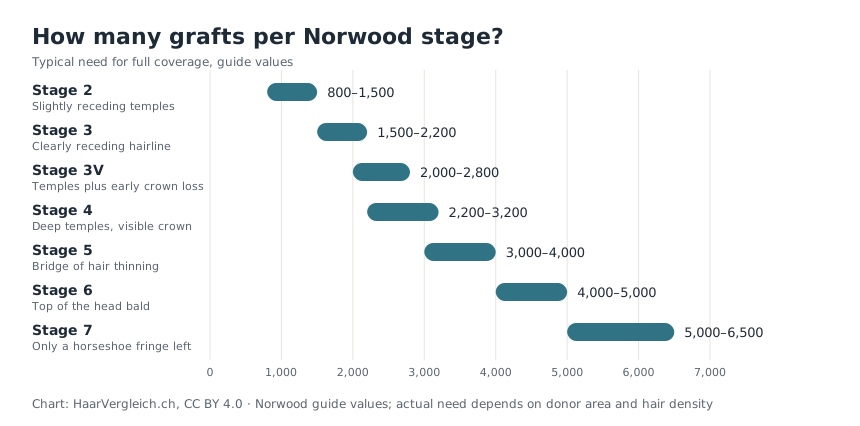
A hair transplant moves DHT-resistant follicles from the back of the head to the hairline. The number of grafts depends on your stage on the Norwood scale:
| Stage | Description | Grafts | Approximate cost in Switzerland |
|---|---|---|---|
| Norwood 2 | Slight recession at the temples | 800–1,500 | CHF 3,000–7,500 |
| Norwood 3 | Deep temple recession, M-shape | 1,500–2,200 | CHF 5,000–11,000 |
| Norwood 3 vertex | As Norwood 3, plus thinning crown | 2,000–2,800 | CHF 6,500–14,000 |
These are guide ranges. Your actual number depends on the size of the area, the desired density, your hair thickness and the quality of your donor area. Use our graft calculator for a first estimate. Methods, recovery and risks are explained in our hair transplant guide.
For a closer look at prices, see what 1,500 grafts and 2,000 grafts cost at Swiss clinics.
The hairline: the most important detail
A transplanted hairline should look so natural that nobody thinks about surgery; hairline design is one of the most important elements of a successful transplant [2,4]. A good hairline is:
- age-appropriate: not too low; it should still suit you at 50 or 60
- irregular: a natural hairline has a soft, slightly zigzag transition zone
- made of single hairs: the front row uses grafts with one hair only
- at the right angle: hairs grow forward and flat, not straight up
Many surgeons use the DHI technique for hairlines because it allows precise placement of single grafts. See our comparison of FUE vs DHI.
Ask for the planned hairline to be drawn on your forehead and photographed before the procedure. A hairline that is too low or too dense is one of the most common reasons for corrections, which cost CHF 5,000 to 12,000 in Switzerland.
Age and planning
Many surgeons prefer to wait until the mid-20s before operating on a receding hairline. In younger men, the final pattern of hair loss is hard to predict. A hairline transplanted at 21 can end up as an isolated strip if the crown later goes bald.
That is why good planning includes:
- stabilising hair loss with medication first, and continuing it after surgery [2,3]
- keeping enough donor hair in reserve for later
- a conservative, age-appropriate hairline
Cost: Switzerland vs abroad
In Switzerland, hair transplants usually cost CHF 3 to 6 per graft. A Turkish package for a similar procedure costs around CHF 1,800 to 3,500, or roughly CHF 2,700 to 5,100 once you add flights, hotel and extras. Follow-up visits and any corrections are much harder to arrange from abroad. More in our comparison of Turkey vs Switzerland.
When a hair transplant makes sense
A transplant is a good option if your temples have clearly receded, your hair loss is stable, and your donor area is strong enough. A Swiss clinic can assess your hairline, set up a medication plan and handle aftercare locally. Compare providers in our clinic comparison or see full prices in our cost overview.
Frequently asked questions
What is the difference between a mature and a receding hairline?
A mature hairline moves back about 1 to 1.5 cm evenly at the temples between the late teens and around 30, then stays stable. A receding hairline keeps moving back, forms a deeper M-shape and the hair in that area gets thinner and finer.
Can a receding hairline grow back?
Medication such as finasteride and minoxidil can stop a receding hairline and thicken thinning hair, but areas that are already bald rarely grow back fully. A hair transplant is the only way to restore a bald hairline permanently.
How many grafts do I need for a receding hairline?
Typically 800 to 1,500 grafts for Norwood 2 and 1,500 to 2,200 grafts for Norwood 3, depending on how far the temples have receded and the density you want.
How much does a hairline transplant cost in Switzerland?
At CHF 3 to 6 per graft, a hairline transplant in Switzerland usually costs from about CHF 3,000 for a small correction to CHF 10,000 or more for a full Norwood 3 hairline.
At what age should I get a hairline transplant?
Many surgeons prefer to wait until the mid-20s, when the pattern of hair loss is easier to predict. Younger patients are usually treated with medication first.
References
Numbers in the text refer to these sources. Links go to PubMed, the publisher (DOI) or the authority.
- Kanti V, Messenger A, Dobos G et al. Evidence-based (S3) guideline for the treatment of androgenetic alopecia in women and in men - short version. J Eur Acad Dermatol Venereol 2018.PubMedDOI
- Rousso DE, Kim SW. A review of medical and surgical treatment options for androgenetic alopecia. JAMA Facial Plast Surg 2014.PubMedDOI
- Queen D, Avram MR. Hair Transplantation: State of the Art. Dermatol Surg 2025.PubMedDOI
- Shapiro R, Shapiro P. Hairline design and frontal hairline restoration. Facial Plast Surg Clin North Am 2013.PubMedDOI
- Messenger AG, Asfour L, Harries M. Frontal Fibrosing Alopecia: An Update. Am J Clin Dermatol 2025.PubMedDOI
This article is for general information and does not replace medical advice. Whether a treatment is right for you can only be determined by an examination with a specialist.