Hair loss has many causes, but most cases fall into a few patterns: hereditary hair loss (androgenetic alopecia), temporary shedding after stress or illness (telogen effluvium), patchy autoimmune hair loss (alopecia areata), and hair loss from deficiencies, hormones or medication [1]. The right treatment depends entirely on the cause, so a diagnosis should always come first.
In short: Shedding 50 to 100 hairs a day is normal. If your hair is visibly thinning, see a doctor to find the cause. Hereditary hair loss responds to minoxidil and finasteride; areas that are already bald need a hair transplant.
How much hair loss is normal?
Every hair goes through a cycle of growth (anagen, two to seven years), transition (catagen, a few weeks) and rest (telogen, about three months), after which it falls out and is replaced. At any time, around 10 to 15% of your hair is resting.
That is why losing around 50 to 100 hairs a day is normal, and more on days you wash or brush your hair. Hair loss becomes a concern when:
- you shed clearly more than usual for several weeks
- your hairline recedes, the crown thins or your parting widens
- bald patches appear suddenly
- the scalp itches, burns, scales or looks red
Types of hair loss at a glance
| Form | Typical signs | Main treatment |
|---|---|---|
| Androgenetic alopecia (men) | Receding temples, thinning crown, gradual over years | Finasteride, minoxidil, hair transplant |
| Androgenetic alopecia (women) | Widening parting, diffuse thinning on top, hairline intact | Minoxidil, anti-androgens (off-label), PRP |
| Telogen effluvium | Sudden diffuse shedding 2–3 months after a trigger | Treat the trigger; usually recovers within months |
| Alopecia areata | Round, smooth bald patches, sometimes eyebrows or beard | Cortisone, newer tablets (JAK inhibitors) in severe cases |
| Traction alopecia | Thinning at temples or edges from tight hairstyles | Change hairstyle early; transplant if permanent |
| Scarring alopecia | Shiny scalp, redness, itching, lost follicle openings | Dermatologist; anti-inflammatory treatment |
| Deficiency or thyroid-related | Diffuse thinning, often with fatigue | Correct iron, thyroid or other deficiency |
| Medication-related | Shedding after starting a new drug or chemotherapy | Review with doctor; often regrows |
Androgenetic alopecia
Hereditary hair loss is by far the most common type [1]. It affects up to 80% of Caucasian men and up to 42% of women, becoming more common with age [2]. Follicles on the top of the head are genetically sensitive to dihydrotestosterone (DHT). Over years, they shrink and produce thinner, shorter hairs until they stop altogether. The hair at the back and sides of the head is resistant, which is why it is used as donor hair in a transplant.
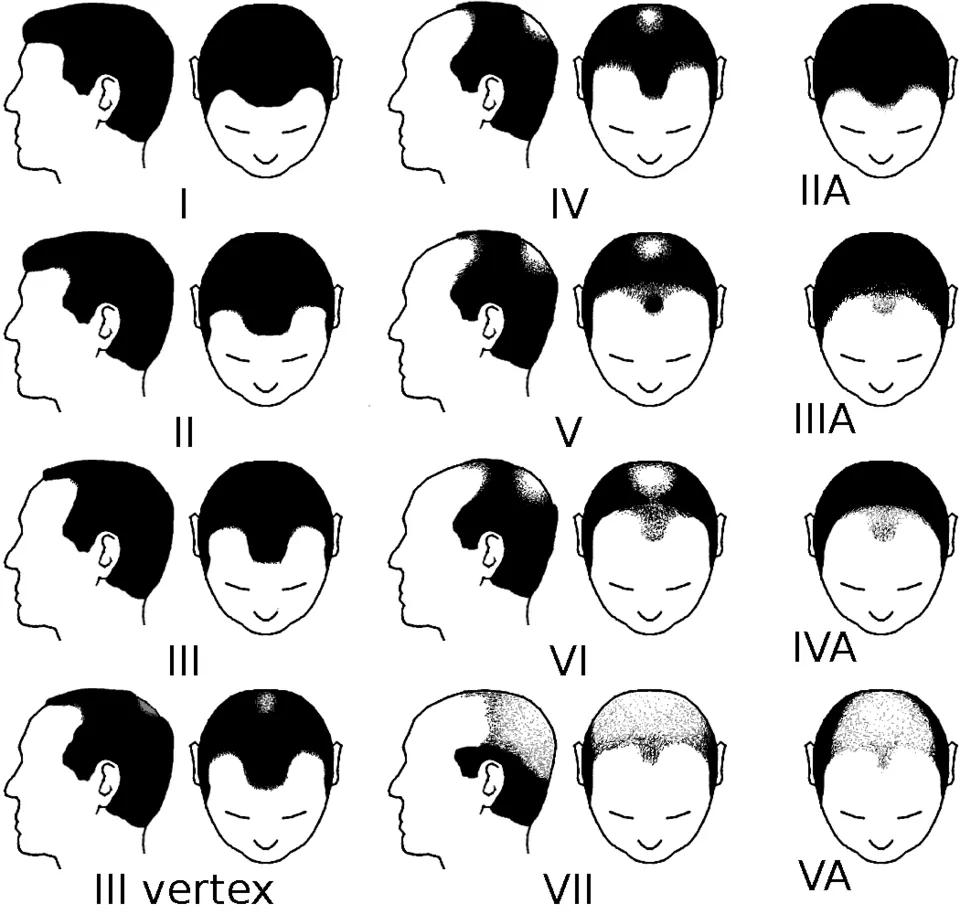
In men, the pattern is described by the Norwood scale, from a slightly receding hairline to a horseshoe-shaped rim. See our overview of hair loss stages to find yours. If your temples are the main concern, read our guide to the receding hairline.
In women, the pattern usually spares the front hairline and shows as a widening parting, described by the Ludwig scale. More in our guide to hair loss in women.
Telogen effluvium
Telogen effluvium is diffuse shedding that typically starts two to three months after a trigger, such as:
- a high fever, COVID-19 or surgery
- childbirth
- a crash diet or rapid weight loss
- severe emotional stress
- stopping the contraceptive pill
The hair comes out in handfuls, which is alarming, but the follicles remain intact. Once the trigger is gone, shedding usually settles within three to six months and hair regrows [1]. If it lasts longer than six months, the doctor will look for an ongoing cause.
Alopecia areata
Alopecia areata is an autoimmune condition in which the immune system attacks hair follicles. It causes round, smooth bald patches, sometimes in the beard or eyebrows. Many patches regrow on their own; others respond to cortisone creams or injections [1]. In severe cases, newer tablets called JAK inhibitors are an option; for baricitinib, the evidence of benefit over placebo is rated high-certainty [4]. Trial results, risks and Swiss approval are covered in our guide to JAK inhibitors for alopecia areata. A hair transplant is not suitable while the disease is active.
Other causes
- Iron deficiency and other deficiencies: low ferritin is a common contributor, especially in women. Severe protein, zinc or vitamin D deficiency can also play a role.
- Thyroid disorders: both an underactive and an overactive thyroid can cause diffuse thinning.
- Hormonal changes: pregnancy, menopause and conditions such as PCOS.
- Medication: for example some antidepressants, blood thinners, retinoids and, most notably, chemotherapy.
- Traction alopecia: tight braids, ponytails or extensions pulling on the hair over years.
- Scarring alopecias: rare inflammatory conditions, such as lichen planopilaris or frontal fibrosing alopecia, that destroy follicles permanently. They need early treatment by a dermatologist.
- Scalp infections: fungal infection (tinea capitis) is more common in children.
How hair loss is diagnosed
A good diagnosis saves you from paying for treatments that cannot work. In Switzerland, start with your GP or, if your insurance model allows direct access, a dermatologist. If you have a GP, HMO or telemedicine model, contact your gatekeeper first, otherwise your insurer may refuse to pay.
The investigation usually includes:
- Medical history: when it started, family history, illnesses, medication, diet, stress and, for women, menstrual cycle and pregnancies.
- Examination: the pattern of loss and a pull test, where the doctor gently pulls on small bundles of hair.
- Trichoscopy: a magnified view of the scalp that shows miniaturised hairs, inflammation or signs of alopecia areata.
- Blood tests: typically ferritin, blood count, thyroid (TSH) and sometimes vitamin D, zinc or hormones. Some hair clinics offer a dedicated hair loss panel, such as the blood test for hair loss at Mara in Zurich.
- Biopsy: only if the cause is unclear or scarring alopecia is suspected.
Basic health insurance usually covers this investigation, subject to your deductible and co-payment. Our guide to health insurance explains what is and is not covered.
See a doctor promptly if hair loss is sudden, patchy, or accompanied by itching, pain, redness, scaling, fatigue or weight change.
Hair loss treatment: what works
| Treatment | Best for | Availability in Switzerland |
|---|---|---|
| Minoxidil (topical) | Hereditary hair loss, men and women | Without prescription in pharmacies |
| Minoxidil (oral, low-dose) | Hereditary hair loss | Prescription, off-label |
| Finasteride 1 mg | Hereditary hair loss in men | Prescription |
| Dutasteride | Hereditary hair loss in men, if finasteride is not enough | Prescription, off-label |
| Spironolactone | Hereditary hair loss in women | Prescription, off-label |
| PRP | Add-on for early to moderate thinning | Private clinics |
| Cortisone, JAK inhibitors | Alopecia areata | Prescription |
| Iron, thyroid treatment | Deficiency or thyroid-related loss | Prescription or over the counter |
| Hair transplant | Stable hereditary loss with bald areas | Specialised clinics |
How strong the evidence is for each of these treatments is compared in our overview Hair loss treatments: what the research really shows.
Medication for hereditary hair loss
Minoxidil prolongs the growth phase and thickens thinning hair. Finasteride lowers DHT and stops hair loss in most men. Combining minoxidil with finasteride works better than minoxidil alone [3], and together they are the standard non-surgical treatment for male pattern baldness [2]. Both work only as long as you use them, and it takes six to twelve months to judge the result.
PRP and other add-ons
PRP uses growth factors from your own blood and may modestly improve density. Microneedling and low-level laser devices have some supporting evidence as add-ons. None of these replaces medication.
Supplements and shampoos
Supplements only help if you actually have a deficiency; evidence for supplementing people with normal levels is lacking [5]. Biotin, for example, rarely makes a difference in people with normal levels and can distort some blood tests. Caffeine or "anti-hair-loss" shampoos have little evidence behind them.
Common myths about hair loss
- "Wearing a cap causes baldness." No. Only very tight headwear or hairstyles that pull on the hair for years can cause traction alopecia.
- "Baldness comes from the mother's side." Partly. One important gene sits on the X chromosome inherited from the mother, but genes from both parents contribute.
- "Washing your hair often makes it fall out." No. Washing only removes hairs that were already about to fall out.
- "Stress makes you go bald." Severe stress can trigger temporary shedding, but it does not cause permanent hereditary baldness.
- "Once hair loss starts, nothing can be done." Wrong. The earlier hereditary hair loss is treated, the more hair can be kept.
When a hair transplant helps
A hair transplant moves DHT-resistant follicles from the back of the head to bald or thinning areas. It is a good option when:
- you have hereditary hair loss with clearly defined bald areas, such as the temples, front or crown
- your hair loss is reasonably stable, ideally with medication
- your donor area at the back and sides is dense enough
- you have realistic expectations about density
It is not suitable for active alopecia areata, active scarring alopecia or temporary shedding such as telogen effluvium. In diffuse thinning without a clear pattern, results are also less predictable.
In Switzerland, a transplant usually costs CHF 3 to 6 per graft; 2,000 grafts typically come to CHF 6,000 to 10,000. Packages in Turkey are cheaper upfront, around CHF 2,700 to 5,100 including flights and extras, but follow-up care is harder to arrange from abroad. See our cost overview and our comparison of Turkey vs Switzerland.
Next steps
- Get a diagnosis from your GP or a dermatologist, including blood tests.
- Treat the cause if there is one, such as iron deficiency or a thyroid disorder.
- Start medication early if you have hereditary hair loss; it protects the hair you still have.
- Consider a transplant once your hair loss is stable and bald areas remain.
Swiss hair transplant clinics offer a diagnosis, a medication plan and surgery under one roof, with aftercare close to home. Compare them in our clinic comparison, or request a free assessment to find out whether you are a candidate.
All articles on Hair loss
Frequently asked questions
How much hair loss is normal per day?
Losing around 50 to 100 hairs a day is normal, and more on days you wash your hair. It becomes a concern if you shed noticeably more for several weeks, or if your hairline, parting or crown visibly thins.
What is the most common cause of hair loss?
Hereditary hair loss, called androgenetic alopecia, is by far the most common cause in both men and women. In men it causes receding temples and a thinning crown; in women it usually thins the hair along the parting.
Can hair loss be reversed?
It depends on the cause. Hair loss from stress, illness, iron deficiency or thyroid problems often recovers once the cause is treated. Hereditary hair loss can be slowed and partly reversed with medication, but bald areas usually need a hair transplant.
Which doctor should I see for hair loss in Switzerland?
Start with your GP, who can order blood tests, or see a dermatologist directly if your insurance model allows it. Dermatologists can examine the scalp with a trichoscope and, if needed, take a biopsy.
What is the best treatment for hair loss?
For hereditary hair loss, the best-supported treatments are minoxidil and, for men, finasteride. Other forms need different treatments, such as cortisone for alopecia areata or iron for a deficiency. A diagnosis comes first.
Is hair loss treatment covered by health insurance in Switzerland?
Basic insurance usually covers the medical investigation of hair loss, subject to your deductible. Treatment of hereditary hair loss, such as finasteride, minoxidil, PRP or a hair transplant, is generally considered cosmetic and not covered.
References
Numbers in the text refer to these sources. Links go to PubMed, the publisher (DOI) or the authority.
- Dakkak M, Forde KM, Lanney H. Hair Loss: Diagnosis and Treatment. Am Fam Physician 2024.PubMed
- Kanti V, Messenger A, Dobos G et al. Evidence-based (S3) guideline for the treatment of androgenetic alopecia in women and in men - short version. J Eur Acad Dermatol Venereol 2018.PubMedDOI
- Zhou Y, Chen C, Qu Q et al. The effectiveness of combination therapies for androgenetic alopecia: A systematic review and meta-analysis. Dermatol Ther 2020.PubMedDOI
- Mateos-Haro M, Novoa-Candia M, Sánchez Vanegas G et al. Treatments for alopecia areata: a network meta-analysis. Cochrane Database Syst Rev 2023.PubMedDOI
- Almohanna HM, Ahmed AA, Tsatalis JP et al. The Role of Vitamins and Minerals in Hair Loss: A Review. Dermatol Ther (Heidelb) 2019.PubMedDOI
This article is for general information and does not replace medical advice. Whether a treatment is right for you can only be determined by an examination with a specialist.