Hair loss & hair transplants for women
Hair transplants for women: when they help and what they cost
Around one in three women experiences noticeable hair loss at some point. Unlike in men, it is usually diffuse, spread across the top of the head. A transplant is therefore not right for every woman, but it is an excellent option for many.
Typical grafts
1,000–3,000
Cost Switzerland (1,500 grafts)
CHF 4,700–8,000
Shaving
Usually not needed (unshaven FUE)
The Ludwig scale: hair loss stages in women
Female hair loss is usually classified using the Ludwig scale. A transplant is most worthwhile in grades I and II, when the donor area is dense.
Ludwig I
Slightly wider parting
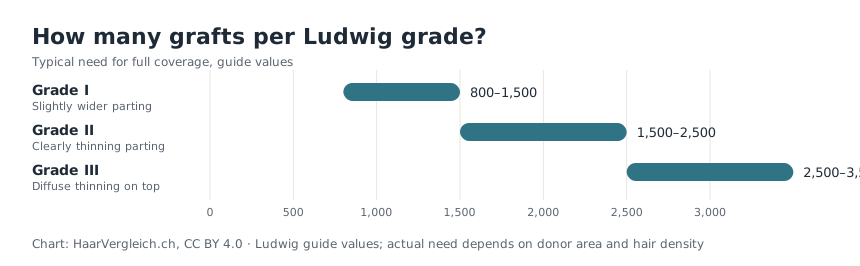
800–1,500 Grafts
Details →Ludwig II
Clearly thinning parting
1,500–2,500 Grafts
Details →Ludwig III
Diffuse thinning on top
2,500–3,500 Grafts
Details →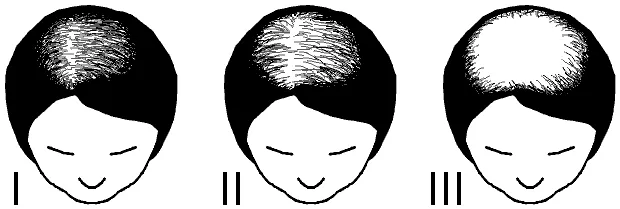
Causes of hair loss in women
The most common cause is hereditary hair loss (androgenetic alopecia), which in women shows as a widening parting while the frontal hairline is usually preserved. It often begins after 30 or during menopause, when oestrogen levels fall.
Other causes must be ruled out first: iron deficiency, thyroid disorders, hormonal changes after pregnancy or stopping the pill, stress (telogen effluvium) and traction alopecia from tight braids or extensions. These forms are often treatable without a transplant.
When a hair transplant makes sense for women
The key is a stable, dense donor area at the back of the head. In many women hair loss is diffuse and affects the back of the head too. Then the hair that could be moved is missing, and a transplant would only redistribute hair that will fall out anyway.
Good candidates are women with a thinning parting and a stable donor area (Ludwig I–II), traction alopecia at the temples or forehead, a high forehead they want lowered, scars after accidents or facelifts, and thin eyebrows.
The procedure: unshaven FUE
Most women do not want to be seen with a shaved head after surgery. Many Swiss clinics therefore offer unshaven FUE or DHI: only a narrow strip under the top hair is shaved at the back, and grafts are placed between existing hairs. It takes longer and costs a little more, but the procedure stays almost invisible.
Surgery takes four to eight hours under local anaesthetic. The scabs are gone after about 10 days, new hair grows from month three and the final result shows after 12 to 18 months.
Medication and alternatives
Before and after a transplant dermatologists usually recommend treatment that slows further loss: minoxidil as a solution or low-dose tablet, sometimes finasteride after menopause, and spironolactone in younger women. PRP or microneedling can complement this.
For women with very diffuse hair loss, medication or a hair system is often a better choice than a transplant.
How much does a hair transplant for women cost?
In Switzerland 1,500 grafts typically cost CHF 4,700 to CHF 8,000, 2,500 grafts CHF 6,400 to CHF 11,200. Unshaven transplants cost 10 to 30 percent more depending on the clinic. Health insurance does not pay for hereditary hair loss; for scars after an accident you can request cost approval.
Frequently asked questions
Can women have a hair transplant?
Yes, if the donor area at the back of the head is dense and stable. That applies to many women with a thinning parting, traction alopecia or a high forehead. With diffuse loss across the whole head it usually does not make sense.
Do I have to shave my head for a hair transplant?
No. With unshaven FUE or DHI only a narrow strip at the back is shaved, hidden by the hair above it.
How much does a hair transplant for women cost in Switzerland?
For 1,500 grafts typically CHF 4,700 to CHF 8,000. Unshaven techniques add 10 to 30 percent depending on the clinic.
How many grafts do women need?
Depending on the area, 1,000 to 3,000 grafts. A thinning parting (Ludwig I) often needs 800 to 1,500, Ludwig II 1,500 to 2,500.
Does a hair transplant help with hair loss during menopause?
Sometimes. Hair loss should first be stabilised with medication. If the donor area is dense enough afterwards, a transplant can add density to the parting.
When will I see results?
New hair grows from month three to four; the final result is visible after 12 to 18 months.