A hair transplant is a surgical procedure, but with modern FUE techniques serious medical complications are rare [1]. Most side effects, such as redness, scabs, swelling and temporary shedding, are part of normal healing. The bigger risk is a poor result: an unnatural hairline, too little density or an over-harvested donor area.
In short: The biggest hair transplant risk is not medical but a matter of planning. A badly placed hairline or an exhausted donor area is very hard to correct later.
Reviews of hair transplant complications agree that most are preventable and arise from poor planning or faulty technique [2]. The procedure is done under local anaesthetic [5], takes five to eight hours, and you go home the same day. Real complications do happen, though, and should be discussed openly before you decide.
Normal side effects in the first weeks
These reactions affect almost every patient and settle on their own:
- Redness and scabs: small crusts form around each graft in the recipient area. They come off after 7 to 14 days.
- Swelling: the forehead and area around the eyes can swell on days 2 to 4. Cooling and sleeping with your head raised help.
- Tightness and mild pain: mainly in the donor area at the back of the head, usually well controlled with standard painkillers.
- Itching: a sign of healing, typically in week 2.
- Numbness: donor and recipient areas can feel less sensitive for weeks to a few months.
For a full week-by-week picture, see our hair transplant recovery timeline.
Shock loss: when hair falls out
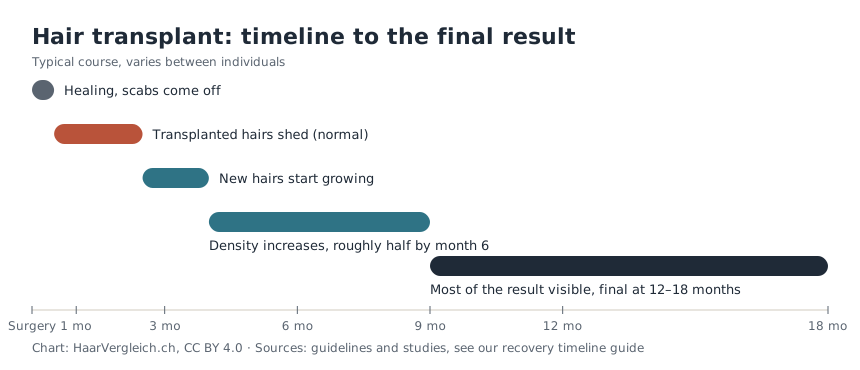
Between weeks 2 and 12, most of the transplanted hairs fall out. This is expected: the follicle stays in the skin and only the hair shaft is shed. New hair starts growing from month 3 to 4.
Less often, existing, non-transplanted hair around the area also falls out temporarily. This is what's usually meant by shock loss, and it mainly affects people whose hair is already weakened. In one series of 621 FUE patients it occurred in fewer than 4%, and far more often in women than in men [3]. In most cases this hair grows back too. Some clinics use PRP or medication alongside the procedure to lower the risk.
Rare complications
| Complication | What it looks like | How common / how serious |
|---|---|---|
| Infection | increasing redness, warmth, pus or fever after day 3 | rare with proper hygiene; treatable |
| Folliculitis | inflamed, pimple-like follicles as new hair breaks through | fairly common, usually harmless |
| Lasting numbness | reduced sensation for months | uncommon, usually improves |
| Cysts | small inclusion cysts | rare, often from grafts placed too deep |
| Thinned donor area | see-through back of head, visible dot scars | caused by over-harvesting; often permanent |
A recent review groups FUE complications into general ones (pain, swelling, bleeding, infection), donor-area problems (pale dot scars, cysts, depletion) and recipient-area problems (folliculitis, lasting redness, shedding, unnatural results) [1]. Smoking, other illnesses, medication, graft handling and the time grafts spend outside the body all influence the risk [1].
Failed hair transplants: the real risks
Most unhappy patients don't have a medical problem but an aesthetic one. Outcomes depend heavily on the operator, and complications are more frequent when surgeons are inadequately trained or the procedure is delegated to unlicensed staff [4]. These are the most common reasons a hair transplant is considered "failed":
- Unnatural hairline: too low, too straight or with dense multi-hair grafts in the front row. A natural hairline is slightly irregular and made of single-hair grafts.
- Too little density: too few grafts spread over too large an area leaves a disappointing, see-through result.
- Progressing hair loss: a good plan must take future hair loss into account [2]; if you are operated on young without one, you can end up with an "island" of transplanted hair a few years later.
- Over-harvested donor area: the donor area is finite. Whatever is taken today is no longer available for later corrections.
- Poor graft survival: caused by rough handling, grafts kept too long outside the body, or packing them too densely. How many grafts typically survive is covered in our guide to hair transplant success rates.
Repairing a failed transplant is possible in some cases but costs CHF 5,000–12,000 in Switzerland and is limited by how much donor hair is left. This is a particular concern after low-cost procedures abroad; see our guide to hair transplant risks in Turkey.
Who is not a good candidate?
Some people carry a higher risk of an unsatisfying result, and a responsible clinic will tell you so:
- Very young patients (under about 25) whose hair loss pattern isn't yet predictable.
- Diffuse thinning across the whole scalp, including the donor area, which leaves little stable hair to move.
- Unclear or non-hereditary causes, such as alopecia areata, thyroid problems or iron deficiency, which need treatment first.
- Unrealistic expectations, for example the density of a teenager at Norwood 6.
- Certain medical conditions or medication, such as blood thinners or poorly controlled diabetes, which need to be discussed with the surgeon.
Being turned down, or told to try medication first, is often a sign of a careful clinic rather than a lost opportunity.
How to reduce your risk
- Diagnosis first: trichoscopy and, where needed, blood tests clarify whether your hair loss is stable and what is causing it.
- Know your surgeon: ask who designs the hairline, opens the channels and extracts the grafts. In Switzerland the procedure must be carried out under a doctor's responsibility.
- Conservative graft numbers: reputable clinics don't transplant more than needed in one session and plan for the future. Our guide on how many grafts you need gives realistic ranges.
- Local aftercare: check-ups at 1, 3, 6 and 12 months catch problems early. That is much easier with a clinic near you than after surgery abroad.
- Medical support: depending on your findings, finasteride, minoxidil or PRP can protect your existing hair.
You can see how Swiss clinics perform on diagnosis and aftercare in our clinic comparison. For the differences compared with going abroad, read Turkey vs Switzerland.
When to contact your clinic straight away
Get in touch with your clinic, or see a doctor, if you notice:
- increasing pain or redness after day 3
- a fever above 38 °C
- pus or foul-smelling wounds
- severe swelling that hasn't settled after a week
- bleeding that doesn't stop with firm pressure
None of these is typical, and most respond well to prompt treatment. Waiting usually makes them worse.
Frequently asked questions
Is a hair transplant dangerous?
An FUE hair transplant is considered a low-risk procedure performed under local anaesthetic. Serious complications are rare. Most problems stem from poor planning, such as an unnatural hairline or an over-harvested donor area.
What is shock loss after a hair transplant?
Shock loss is the temporary shedding of hair in the recipient or donor area, typically between weeks 2 and 12 after surgery. The follicles stay in place, and the hair usually grows back after 3 to 4 months.
Can a hair transplant fail?
Yes. Typical failures are a hairline that is too low or too straight, visible scarring in the donor area from over-harvesting, or poor graft growth. Careful planning by an experienced surgeon reduces these risks considerably.
What are the side effects of a hair transplant?
Almost everyone has redness, small scabs, some swelling of the forehead and a feeling of tightness for the first one to two weeks. Itching and temporary numbness are also common. These are part of normal healing and fade on their own.
How long is it obvious that I had a hair transplant?
Redness and small scabs are visible for about 7 to 14 days. After that, the procedure is hard for others to spot, especially if your whole head was not shaved.
References
Numbers in the text refer to these sources. Links go to PubMed, the publisher (DOI) or the authority.
- Romera de Blas C, Vega Díez D, Ricart Vayá JM et al. Complications in follicular unit excision hair transplantation: current evidence and practical approaches. Front Med (Lausanne) 2026.PubMedDOI
- Nadimi S. Complications with Hair Transplantation. Facial Plast Surg Clin North Am 2020.PubMedDOI
- Okochi H, Onda M, Momosawa A et al. An Analysis of Risk Factors of Recipient Site Temporary Effluvium After Follicular Unit Excision: A Single-Center Retrospective Study. Aesthetic Plast Surg 2024.PubMedDOI
- Williams KL Jr, El-Maghraby S. Complications with Follicular Unit Excision. Facial Plast Surg 2024.PubMedDOI
- Jimenez F, Vogel JE, Avram M. CME article Part II. Hair transplantation: Surgical technique. J Am Acad Dermatol 2021.PubMedDOI
This article is for general information and does not replace medical advice. Whether a treatment is right for you can only be determined by an examination with a specialist.