Most people need between 1,000 and 3,000 grafts for a single hair transplant: around 800–1,500 for mild receding temples, 1,500–2,200 for Norwood 3 and 3,000 or more once the crown is involved. The graft count is the main driver of effort, result and price, so it pays to know your range before you compare quotes.
In short: Use the chart below for a first estimate, then check it with our graft calculator. A good clinic should explain exactly why it recommends its number.
A graft is not a hair
A graft is a natural group of hair follicles as it grows in the scalp, also called a follicular unit. One graft contains 1 to 4 hairs, often around 2 on average. Grafts harvested by FUE tend to contain slightly more hairs than grafts from the strip method, because surgeons can pick fuller units [3]. For the very front row of the hairline the surgeon uses single-hair grafts; behind that, grafts with 2 to 3 hairs build density.
Converting grafts to hairs
| Grafts | Approximate hairs |
|---|---|
| 1,000 | 2,000–2,500 |
| 2,000 | 4,000–5,000 |
| 3,000 | 6,000–7,500 |
| 4,000 | 8,000–10,000 |
Watch whether a quote talks about grafts or hairs. "6,000 hairs" sounds like more, but it equals only about 2,700 grafts. Clinics that quote hairs instead of grafts are not necessarily dishonest, but it makes comparison harder.
Graft chart by Norwood stage (men)
Not sure which stage you are? Our illustrated hair loss stages guide shows each pattern.
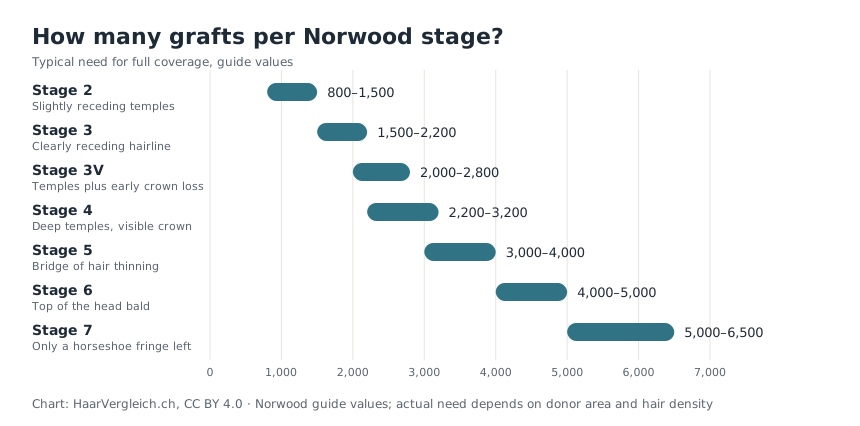
| Stage | Description | Grafts |
|---|---|---|
| Norwood 2 | mild receding temples | 800–1,500 |
| Norwood 3 | clear receding temples | 1,500–2,200 |
| Norwood 3 Vertex | temples plus crown | 2,000–2,800 |
| Norwood 4 | thinning front, crown starting | 2,200–3,000 |
| Norwood 5 | front and crown, narrow bridge | 3,000–3,800 |
| Norwood 6 | bridge gone | 3,800–4,800 |
| Norwood 7 | only a horseshoe fringe left | 4,500–6,000 (usually 2 sessions) |
These figures are guidelines for a natural, medium density. Your actual need depends on head shape, hair thickness, the contrast between hair and skin colour, and the density you want. Fine, light hair on fair skin often needs fewer grafts for the same visual effect than thick dark hair on light skin, because the contrast is lower.
Graft chart for women (Ludwig scale)
| Stage | Description | Grafts |
|---|---|---|
| Ludwig 1 | slightly wider parting | 800–1,500 |
| Ludwig 2 | clearly thinner top | 1,500–2,500 |
| Ludwig 3 | widespread thinning | 2,500–3,500 |
For women, a careful diagnosis beforehand is especially important, as diffuse thinning often has hormonal or nutritional causes that a transplant cannot fix. Read more on hair transplants for women.
Density: why more isn't always better
Natural, full hair has around 80 to 100 follicular units per cm². After a transplant, roughly 35 to 50 grafts per cm² usually create a convincingly dense look; a practice guideline recommends a minimum of 35 to 45 units per cm² [1]. Placing more than about 30 to 35 grafts per cm² in one session is called dense packing, and not every patient is a suitable candidate [2]. Higher densities use up more of your donor reserve and can lower graft survival. What studies show about graft survival after a hair transplant is covered in a separate guide.
Your donor area is finite
Over a lifetime, the back of the head provides roughly 5,000 to 7,000 grafts with FUE. If you are young and your hair loss is still progressing, part of this reserve should be kept for later; guidelines urge caution in very young patients whose hair loss is still evolving [1]. A good surgeon plans not only for today, but for how you will look in ten to twenty years.
Beard or body hair can serve as an extra source in some cases [4], though it is less predictable than scalp hair. Medication such as finasteride or minoxidil can also protect the hair you still have, which reduces how many grafts you may need in future [1,5].
What do 1,000, 2,000 or 3,000 grafts cost in Switzerland?
A hair transplant in Switzerland costs around CHF 3 to 6 per graft, depending on clinic and scope. Many clinics use package prices where the per-graft price falls as the number rises.
| Grafts | Typical Swiss price |
|---|---|
| 1,000 | CHF 3,500–6,000 |
| 2,000 | CHF 6,000–10,000 |
| 3,000 | CHF 9,000–14,000 |
See the detailed page for 2,000 grafts, or current prices for all compared clinics on our cost page.
Why clinics quote different numbers
It's common to receive two quotes for the same scalp that differ by several hundred grafts. There are a few legitimate reasons:
- Different goals: one clinic may plan a lower, denser hairline, the other a more conservative, mature one.
- Different areas: one plan may include the crown, the other only the front.
- Different density targets: 35 versus 50 grafts per cm² makes a big difference over a large area.
- Different assessments of your donor area, which limits what is possible.
There are also less legitimate reasons. When a clinic charges per graft, a higher number means a higher bill; with "unlimited grafts" packages, the incentive can be to harvest as much as possible. Either way, the number should follow from your diagnosis, not the other way round.
Questions to ask about any graft number
- How did you arrive at this number, and for which area exactly?
- How many grafts will remain in my donor area afterwards?
- What happens if fewer or more grafts are placed than quoted?
- Would medication change the plan?
If two clinics give you very different numbers for the same scalp, ask both to explain. A difference of a few hundred grafts is normal; a difference of 2,000 is a warning sign.
Getting a reliable estimate
Online charts and calculators give you a sensible starting range, but only an examination can confirm it. During a consultation, the doctor will usually measure the recipient area, assess the density and quality of your donor hair with a magnifying device, and look at how active your hair loss is. Some clinics also photograph and map the scalp so you can see exactly where the grafts will go.
Bring your own estimate to the appointment. If the clinic's number falls well outside it, that is not necessarily wrong, but it should come with a clear explanation. Our guide on how to choose a clinic lists the other questions worth asking.
Frequently asked questions
How many hairs are in one graft?
A graft (follicular unit) contains on average around 2 to 2.5 hairs, ranging from 1 to 4 depending on the person. So 2,000 grafts correspond to roughly 4,000 to 5,000 hairs.
How many grafts do I need for receding temples?
For mild to moderate receding temples (Norwood 2 to 3), most people need around 1,000 to 2,200 grafts, depending on the extent and the density you want.
Is 2,000 grafts a lot?
2,000 grafts is a typical medium-sized procedure, usually enough to rebuild a hairline and the front third of the scalp at Norwood 3. It is not enough to cover an advanced Norwood 6 or 7 pattern.
How many grafts can be done in one session?
Reputable clinics usually transplant 2,000 to 4,000 grafts per session. Higher numbers are possible but put more strain on the donor area and can reduce graft survival.
How many grafts are available in total?
The donor area usually provides around 5,000 to 7,000 grafts over a lifetime with FUE, somewhat more with very dense hair. This reserve needs to be planned carefully.
References
Numbers in the text refer to these sources. Links go to PubMed, the publisher (DOI) or the authority.
- Patwardhan N, Mysore V. Hair transplantation: standard guidelines of care. Indian J Dermatol Venereol Leprol 2008.PubMed
- Farjo B, Farjo N. Dense packing: surgical indications and technical considerations. Facial Plast Surg Clin North Am 2013.PubMedDOI
- Takata Pontes L, Ruston A, de Moraes AM. Strip Harvesting Follicular Unit Transplantation Versus Follicular Unit Excision: Comparing the Number of Hairs and the Ratio of Hairs to Follicular Unit. Dermatol Surg 2024.PubMedDOI
- Garg AK, Garg S. Donor Harvesting: Follicular Unit Excision. J Cutan Aesthet Surg 2018.PubMedDOI
- Queen D, Avram MR. Hair Transplantation: State of the Art. Dermatol Surg 2025.PubMedDOI
This article is for general information and does not replace medical advice. Whether a treatment is right for you can only be determined by an examination with a specialist.