JAK inhibitors are tablets that calm the immune attack on hair follicles in alopecia areata. They are the first treatments proven in large trials to regrow hair in severe cases. In phase 3 trials, about 30 to 40% of patients who had lost at least half their scalp hair regained at least 80% coverage on the higher doses, against under 7% on placebo [2,5]. In Switzerland, baricitinib and ritlecitinib are authorised for severe alopecia areata [12,13].
In short: JAK inhibitors work for many, but not all, patients with severe alopecia areata. They need months to act, must usually be continued to keep the hair, and require blood tests and monitoring by a dermatologist. A hair transplant is not a solution for active alopecia areata.
What is alopecia areata, and how do JAK inhibitors help?
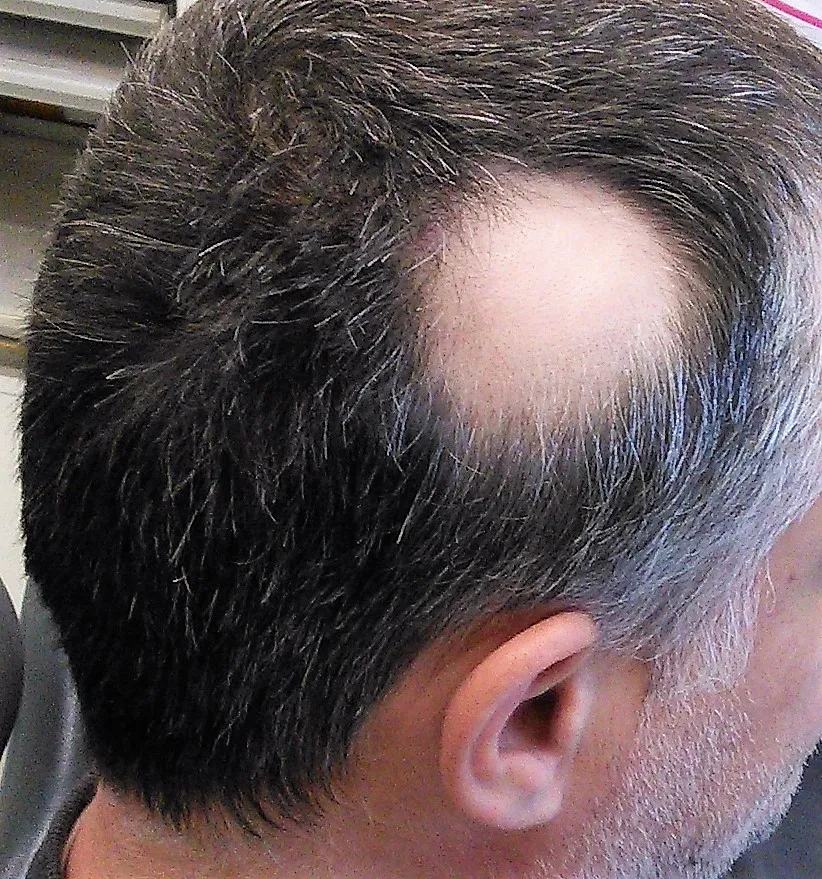
Alopecia areata is an autoimmune disease: immune cells attack hair follicles, causing round bald patches or, in severe forms, loss of all scalp hair (alopecia totalis) or all body hair (alopecia universalis). The follicles are not destroyed, which is why hair can regrow.
Janus kinases (JAKs) are signalling enzymes inside immune cells. Blocking them interrupts the inflammatory signals that drive the attack. The drugs in this guide differ in which kinases they block:
| Drug | Targets | Dose in trials | Status in Switzerland |
|---|---|---|---|
| Baricitinib (Olumiant) | JAK1/JAK2 | 2 or 4 mg once daily | Authorised for severe AA in adults up to 60 [13] |
| Ritlecitinib (Litfulo) | JAK3/TEC | 50 mg once daily | Authorised since 3 Feb 2025, ages 12–65 [12] |
| Deuruxolitinib | JAK1/JAK2 | 8 or 12 mg twice daily | Ask your dermatologist about availability |
How severity is measured: the SALT score
Trials use the Severity of Alopecia Tool (SALT), which scores scalp hair loss from 0 (no hair loss) to 100 (complete loss) [2]. The usual trial target is SALT 20 or less, meaning at least 80% of the scalp is covered. A European expert consensus considers a SALT score of 20 or more a common indication for systemic treatment [1].
Key trials at a glance
| Trial | Design | n | Result (SALT ≤20) |
|---|---|---|---|
| BRAVE-AA1 & AA2, baricitinib, NEJM 2022 [2] | Two phase 3 RCTs, 36 weeks | 1,200 | 4 mg: 38.8% and 35.9%; 2 mg: 22.8% and 19.4%; placebo: 6.2% and 3.3% |
| BRAVE-AA1 withdrawal, JAMA Dermatol 2024 [4] | Randomised withdrawal after 52 weeks | 154 responders | 80% lost response by week 152 after stopping vs 7% who continued |
| ALLEGRO, ritlecitinib, Lancet 2023 [5] | Phase 2b/3 RCT, 24 weeks, age 12+ | 718 | 50 mg: 23%; 200/50 mg: 31%; placebo: 2% |
| ALLEGRO-LT, BJD 2025 [6] | Long-term extension | 385 | 50 mg: 45% at 12 months, 61% at 24 months (observed) |
| THRIVE-AA1, deuruxolitinib, JAAD 2024 [8] | Phase 3 RCT, 24 weeks | – | 8 mg: 29.6%; 12 mg: 41.5%; placebo: 0.8% |
| THRIVE-AA2, deuruxolitinib, JAAD 2026 [9] | Phase 3 RCT, 24 weeks | 517 | 8 mg: 33.0%; 12 mg: 38.3%; placebo: 0.8% |
Baricitinib: the BRAVE-AA trials
The two BRAVE-AA trials enrolled 1,200 adults with SALT scores of 50 or higher. After 36 weeks, 36 to 39% on 4 mg reached SALT 20 or less, compared with 19 to 23% on 2 mg and 3 to 6% on placebo [2]. A Cochrane review rated the evidence that baricitinib increases both short- and long-term hair regrowth as high-certainty. For other alopecia areata treatments, the evidence was very uncertain [3].
In Switzerland, the recommended starting dose is 4 mg, reduced to 2 mg once a stable response is reached. Treatment should be stopped if there is no meaningful response (at least 25% SALT improvement) after 36 weeks. It should generally not continue beyond one year unless the benefit clearly outweighs the risks [13].
Ritlecitinib: the ALLEGRO trials
Ritlecitinib was tested in 718 patients aged 12 and older with at least 50% scalp hair loss. At 24 weeks, 23% on the 50 mg dose and 31% on a 200 mg loading dose followed by 50 mg reached SALT 20 or less, versus 2% on placebo [5]. Results kept improving with longer use: among patients on 50 mg, 45% had reached the target at one year and 61% at two years (observed data). Eyebrow and eyelash regrowth also increased [6]. Ritlecitinib is the only option in this group authorised from age 12 [12].
Deuruxolitinib: the THRIVE-AA trials
Deuruxolitinib was tested in two phase 3 trials in adults aged 18 to 65. At 24 weeks, 30 to 42% of patients reached SALT 20 or less on deuruxolitinib, compared with 0.8% on placebo [8,9]. Satisfaction with hair growth tracked the objective results [8]. Both trials were short, and long-term durability has not yet been reported [9].
Side effects and safety
JAK inhibitors suppress parts of the immune system, so monitoring matters.
- Baricitinib: acne, raised creatine kinase and higher LDL and HDL cholesterol were more common than with placebo [2].
- Ritlecitinib: in 1,294 patients followed for a median of 624 days, serious side effects occurred in 4.4% and 6.0% stopped because of side effects. Headache was the most common. Shingles (herpes zoster) affected 1.5%, cancer (excluding non-melanoma skin cancer) 0.5%, and major cardiovascular events 0.2% [7].
- Deuruxolitinib: most side effects were mild or moderate [8,9].
A meta-analysis of seven trials found that JAK inhibitors were not linked to more severe side effects than placebo [10]. Another, covering 35 trials in skin diseases, found no significant increase in heart attacks, strokes, deaths or blood clots. However, follow-up averaged only about five months [11].
The Swiss product information for baricitinib nevertheless carries a boxed warning on serious infections, mortality, cancer, major cardiovascular events and blood clots. It is based largely on a large trial of another JAK inhibitor in patients with rheumatoid arthritis aged 50 or older with cardiovascular risk factors. For patients over 65, it should be used only if no suitable alternatives exist [13]. Before starting, expect screening for tuberculosis and hepatitis, blood counts, liver values and lipids, and a review of vaccinations.
Relapse: why treatment is usually long term
Alopecia areata is chronic and relapsing. In the BRAVE-AA1 withdrawal study, responders who stopped baricitinib after one year mostly lost their regrowth: 80% had lost benefit by week 152, compared with 7% of those who stayed on treatment. Most who restarted regained a good response [4]. In practice, JAK inhibitors control the disease rather than cure it.
Why a hair transplant is not suitable for active alopecia areata
Hair transplants are designed for pattern hair loss, where follicles in the donor area are genetically resistant. In alopecia areata the problem is an immune attack that can affect any follicle, including transplanted ones. Bald patches may also regrow by themselves or with treatment. Hair surgeons therefore generally advise against transplanting in active alopecia areata. If you are unsure which type of hair loss you have, see a dermatologist before consulting a clinic. Our hair transplant guide explains who is a good candidate.
How strong is the evidence?
- Efficacy: strong. Several large, double-blind phase 3 RCTs exist for three drugs, and Cochrane rates the baricitinib evidence as high-certainty [2,3,5,8,9].
- Long-term outcomes: moderate. Extension studies run up to two to three years, but they are open-label and partly based on observed data [6].
- Long-term safety: uncertain. Trials are short relative to lifelong disease, and serious risks are rare events. The boxed warnings rely on data from other diseases and older populations [11,13].
- Head-to-head data: none. There are no trials comparing the JAK inhibitors directly, so it is unclear which is best for whom.
- Industry funding: the pivotal trials were funded by the manufacturers [2,5].
For an overview of the evidence for all hair loss treatments, see our evidence review.
Practical steps in Switzerland
- Get a diagnosis from a dermatologist, ideally one with a hair clinic.
- Ask whether your severity (usually at least 50% scalp loss) and age fit the Swiss label.
- Clarify cost coverage with your health insurer in advance. These are expensive medicines; read our guide on health insurance.
- Plan for regular blood tests and follow-up visits.
Patchy, mild alopecia areata is usually treated locally first, for example with steroid injections. JAK inhibitors are intended for severe forms.
Frequently asked questions
How well do JAK inhibitors work for alopecia areata?
In phase 3 trials of patients who had lost at least half their scalp hair, about 30 to 40% on the higher doses regained at least 80% scalp coverage within 24 to 36 weeks, compared with under 7% on placebo. Response often keeps improving over the second year.
Does hair fall out again after stopping a JAK inhibitor?
Usually yes. In the BRAVE-AA1 trial, 80% of patients who stopped baricitinib after a year had lost their response by week 152, compared with 7% of those who continued. Most regained their hair when treatment was restarted.
What are the side effects of JAK inhibitors?
Common side effects include acne, headache, upper respiratory infections and changes in blood tests such as cholesterol and creatine kinase. Shingles and serious infections are less common. The Swiss product information carries a boxed warning on serious infections, cancer, heart events and blood clots, based mainly on data in older patients with rheumatoid arthritis.
Are JAK inhibitors for alopecia areata available in Switzerland?
Yes. Baricitinib (Olumiant) is authorised for severe alopecia areata in adults up to 60, and ritlecitinib (Litfulo) has been authorised since February 2025 for patients aged 12 to 65. Both need a prescription from an experienced dermatologist, and insurance coverage should be clarified in advance.
Can a hair transplant treat alopecia areata?
Generally no. Alopecia areata is an autoimmune disease that can attack transplanted follicles just as it attacks native ones, and the hair often regrows by itself or with medical treatment. A transplant is designed for pattern hair loss.
References
Numbers in the text refer to these sources. Links go to PubMed, the publisher (DOI) or the authority.
- Rudnicka L, Arenbergerova M, Grimalt R et al. European expert consensus statement on the systemic treatment of alopecia areata. J Eur Acad Dermatol Venereol 2024.PubMedDOI
- King B, Ohyama M, Kwon O et al. Two Phase 3 Trials of Baricitinib for Alopecia Areata. N Engl J Med 2022.PubMedDOI
- Mateos-Haro M, Novoa-Candia M, Sánchez Vanegas G et al. Treatments for alopecia areata: a network meta-analysis. Cochrane Database Syst Rev 2023.PubMedDOI
- King B, Ko J, Kwon O et al. Baricitinib Withdrawal and Retreatment in Patients With Severe Alopecia Areata: The BRAVE-AA1 Randomized Clinical Trial. JAMA Dermatol 2024.PubMedDOI
- King B, Zhang X, Harcha WG et al. Efficacy and safety of ritlecitinib in adults and adolescents with alopecia areata: a randomised, double-blind, multicentre, phase 2b-3 trial. Lancet 2023.PubMedDOI
- Piliang M, Soung J, King B et al. Efficacy and safety of the oral Janus kinase 3/tyrosine kinase expressed in hepatocellular carcinoma family kinase inhibitor ritlecitinib over 24 months: integrated analysis of the ALLEGRO phase IIb/III and long-term phase III clinical studies in alopecia areata. Br J Dermatol 2025.PubMedDOI
- King B, Soung J, Tziotzios C et al. Integrated Safety Analysis of Ritlecitinib, an Oral JAK3/TEC Family Kinase Inhibitor, for the Treatment of Alopecia Areata from the ALLEGRO Clinical Trial Program. Am J Clin Dermatol 2024.PubMedDOI
- King B, Senna MM, Mesinkovska NA et al. Efficacy and safety of deuruxolitinib, an oral selective Janus kinase inhibitor, in adults with alopecia areata: Results from the Phase 3 randomized, controlled trial (THRIVE-AA1). J Am Acad Dermatol 2024.PubMedDOI
- Tsianakas A, Passeron T, Magnolo N et al. Efficacy and safety of deuruxolitinib, an oral selective Janus kinase 1/2 inhibitor, in adults with alopecia areata: Results from the THRIVE-AA2 Phase 3, randomized, double-blind, controlled trial. J Am Acad Dermatol 2026.PubMedDOI
- Liu M, Gao Y, Yuan Y et al. Janus Kinase Inhibitors for Alopecia Areata: A Systematic Review and Meta-Analysis. JAMA Netw Open 2023.PubMedDOI
- Ingrassia JP, Maqsood MH, Gelfand JM et al. Cardiovascular and Venous Thromboembolic Risk With JAK Inhibitors in Immune-Mediated Inflammatory Skin Diseases: A Systematic Review and Meta-Analysis. JAMA Dermatol 2024.PubMedDOI
- Swissmedic: Litfulo (ritlecitinib) – new authorisation.
- Swissmedicinfo: Fachinformation Olumiant (baricitinib).
This article is for general information and does not replace medical advice. Whether a treatment is right for you can only be determined by an examination with a specialist.